Key takeaways
- A power bank is a portable lithium-ion battery that charges phones and other devices through USB.
- It delivers about 60 to 70 percent of its rated mAh, because it boosts its 3.7 V cells to 5 V or more and loses some energy as heat.
- Most power banks are rated for about 300 to 500 full charge cycles, typically 2 to 3 years of regular use.
- The FAA allows power banks up to 100 Wh in carry-on bags, and 100 to 160 Wh with airline approval; a 20,000 mAh bank holds about 74 Wh.
A power bank is a portable battery pack, usually lithium-ion, that stores energy and charges phones, earbuds, tablets and some laptops through USB ports. This guide covers how a power bank works, what mAh and Wh mean, why it delivers less than its rated capacity, how many phone charges to expect, how long one lasts, and the rules for flying with one.
How does a power bank work?
A power bank works in 3 steps: it charges its lithium-ion cells from a wall charger, stores the energy at about 3.7 V per cell, and boosts that voltage to the 5 V or higher that USB devices need when you plug something in.
- Charging. A USB charger fills the cells.
- Storing. Lithium-ion cells hold the energy at about 3.7 V.
- Boosting. A circuit raises the voltage to 5 V or more for USB output, and higher still for fast-charging laptops.
Step 3 is where some energy is lost as heat, which is why a power bank never delivers its full rated capacity.
What do mAh and Wh mean on a power bank?
mAh (milliamp-hours) measures a battery's charge at its cell voltage, and Wh (watt-hours) measures the energy it holds. Multiply mAh by 3.7 and divide by 1,000 to get Wh: a 20,000 mAh power bank holds about 74 Wh.
Watt-hours are the better way to compare batteries, because they include voltage. Our amp-hours to watt-hours guide explains the conversion in more detail.
Why does a power bank give less than its rated capacity?
A power bank gives less than its rated capacity because boosting 3.7 V cells to 5 V or more wastes energy as heat. Anker says a 20,000 mAh power bank delivers about 12,000 to 14,000 mAh, around 60 to 70 percent of its rating.
Temperature, cable quality and the battery's age reduce usable output further. Fast charging at higher voltages adds conversion losses too.
How many phone charges does a power bank give?
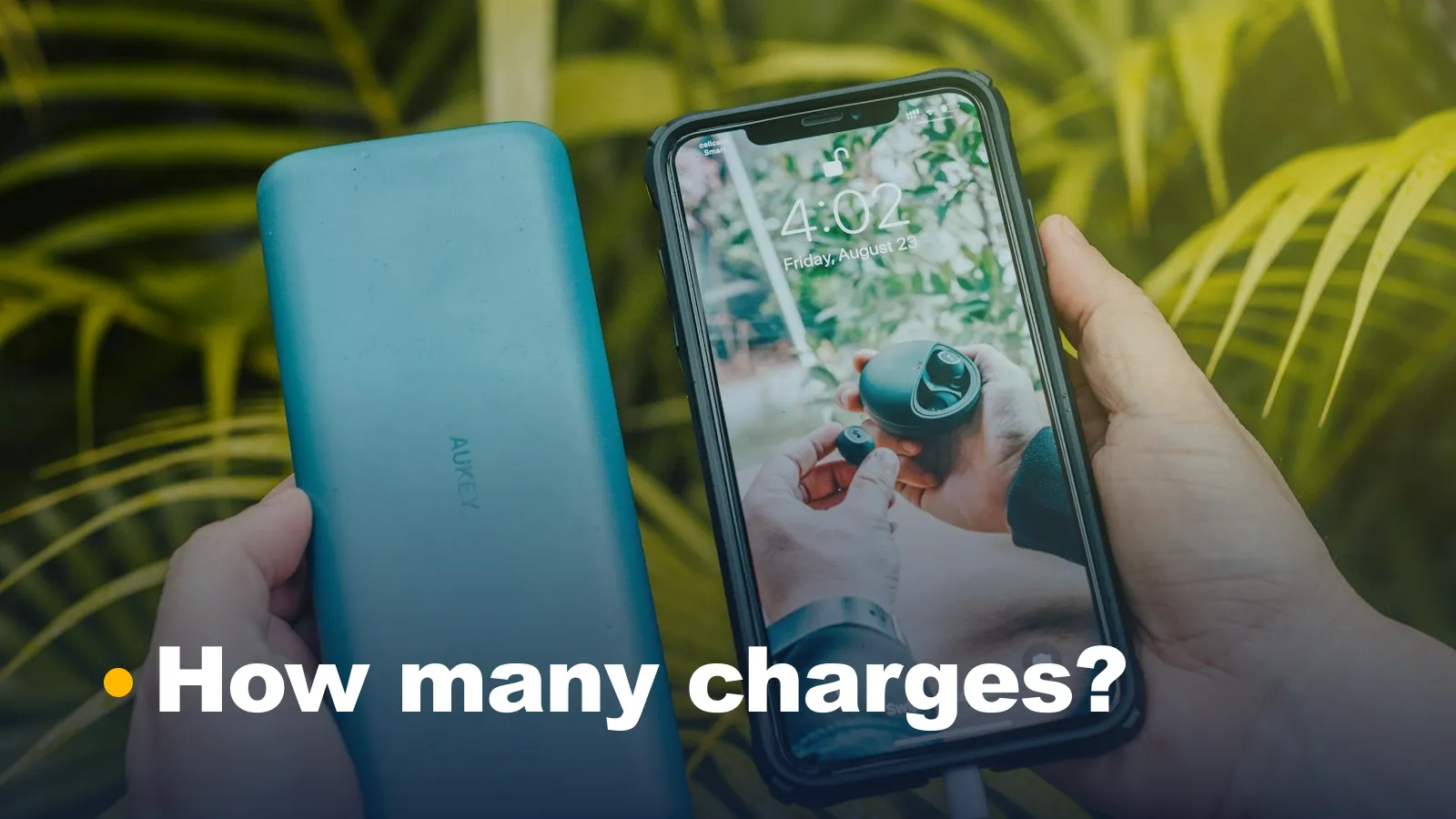
A power bank gives its usable watt-hours divided by your phone battery's watt-hours. A phone battery holds about 10 to 20 Wh, so a 20,000 mAh power bank gives roughly 2 to 5 full charges, depending on the phone.
How long does a power bank last?
A power bank lasts about 300 to 500 full charge cycles, which Anker says works out to about 2 to 3 years before its performance noticeably drops. A power bank used once a day ages faster than one used occasionally.
A charge cycle is one full use of the battery's capacity, so 2 half charges count as 1 cycle. Heat, deep discharges and long storage at full charge shorten battery life. A power bank also loses some charge while stored, so top it up every few months.
Can you take a power bank on a plane?
Yes, in carry-on bags only. The FAA allows lithium batteries up to 100 Wh in carry-on bags without approval and 100 to 160 Wh with airline approval, and power banks are not allowed in checked bags.
Most phone power banks, up to about 27,000 mAh at 3.7 V, stay under 100 Wh. For more power than a power bank holds, such as for a laptop and lights in an outage, a portable power station is the next size up. Our guide to what a portable power station is explains the difference, and our best portable power stations guide compares 5 large models.
Common questions
Can I take a power bank on a plane?
Yes, in carry-on bags only. The FAA allows lithium batteries up to 100 Wh without approval and 100 to 160 Wh with airline approval. A 20,000 mAh power bank at 3.7 V holds about 74 Wh.
Is it bad to leave a power bank plugged in?
Modern power banks stop charging when full, but long storage at full charge and heat age the battery faster. Store one partly charged in a cool place.
What is the difference between a power bank and a power station?
Size and outlets. A power bank holds under 100 Wh and charges phones over USB, while a portable power station holds hundreds or thousands of Wh and has AC outlets for laptops, lights and appliances.
Writes guides and reviews for ProductHunter.