Key takeaways
- Watt-hours = amp-hours × volts, and amp-hours = watt-hours ÷ volts.
- Watt-hours = milliamp-hours × volts ÷ 1,000.
- A 12 V 100 Ah battery holds 1,200 Wh; a LiFePO4 one at 12.8 V holds 1,280 Wh.
- Compare batteries in watt-hours, because amp-hours mean nothing without the voltage.
An amp-hour (Ah) is a unit of electric charge that describes how much current a battery delivers over time, and a watt-hour (Wh) is a unit of energy that also accounts for voltage. Converting between them takes one multiplication or division by the battery's voltage. This guide covers the formulas for Ah, Wh and mAh, worked examples for common batteries, which voltage to use, the difference between amps and amp-hours, and how to turn watt-hours into runtime.
How do you convert amp-hours to watt-hours?
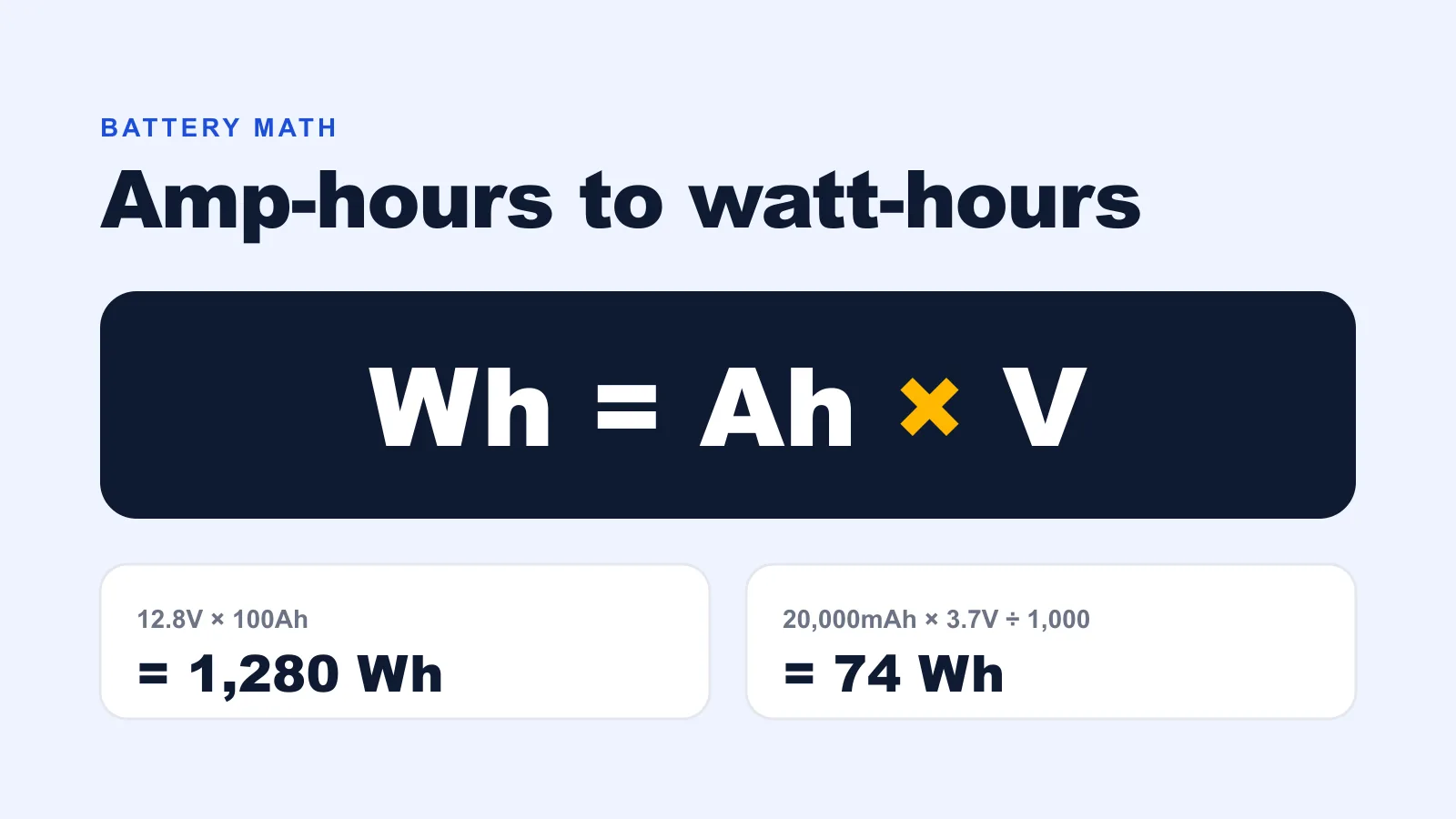
Multiply the amp-hours by the battery's voltage: Wh = Ah × V. A 12 V battery rated at 100 Ah holds 12 × 100 = 1,200 Wh. To go the other way, divide: Ah = Wh ÷ V.
The 3 formulas cover every conversion:
| Conversion | Formula | Example |
|---|---|---|
| Amp-hours to watt-hours | Wh = Ah × V | 100 Ah × 12 V = 1,200 Wh |
| Watt-hours to amp-hours | Ah = Wh ÷ V | 1,200 Wh ÷ 12 V = 100 Ah |
| Milliamp-hours to watt-hours | Wh = mAh × V ÷ 1,000 | 20,000 mAh × 3.7 V ÷ 1,000 = 74 Wh |
How do you convert mAh to watt-hours?
Multiply the milliamp-hours by the voltage and divide by 1,000. A milliamp-hour (mAh) is one thousandth of an amp-hour, the unit phone and power bank makers use for small batteries.
Power banks list their capacity at the internal cell voltage, usually 3.6 to 3.7 V, not at the 5 V of their USB output. A 10,000 mAh power bank at 3.7 V holds 37 Wh, and a 20,000 mAh one holds 74 Wh.
How many watt-hours are common batteries?
Common batteries range from about 15 Wh in a phone to over 5,000 Wh in a 48 V home battery. The table converts typical sizes with the formula Wh = Ah × V.
| Battery | Voltage | Capacity | Watt-hours |
|---|---|---|---|
| Power bank | 3.7 V | 10,000 mAh | 37 Wh |
| Power bank | 3.7 V | 20,000 mAh | 74 Wh |
| 12 V lead-acid or AGM | 12 V | 100 Ah | 1,200 Wh |
| 12 V LiFePO4 | 12.8 V | 100 Ah | 1,280 Wh |
| 24 V LiFePO4 | 25.6 V | 100 Ah | 2,560 Wh |
| 48 V LiFePO4 | 51.2 V | 100 Ah | 5,120 Wh |
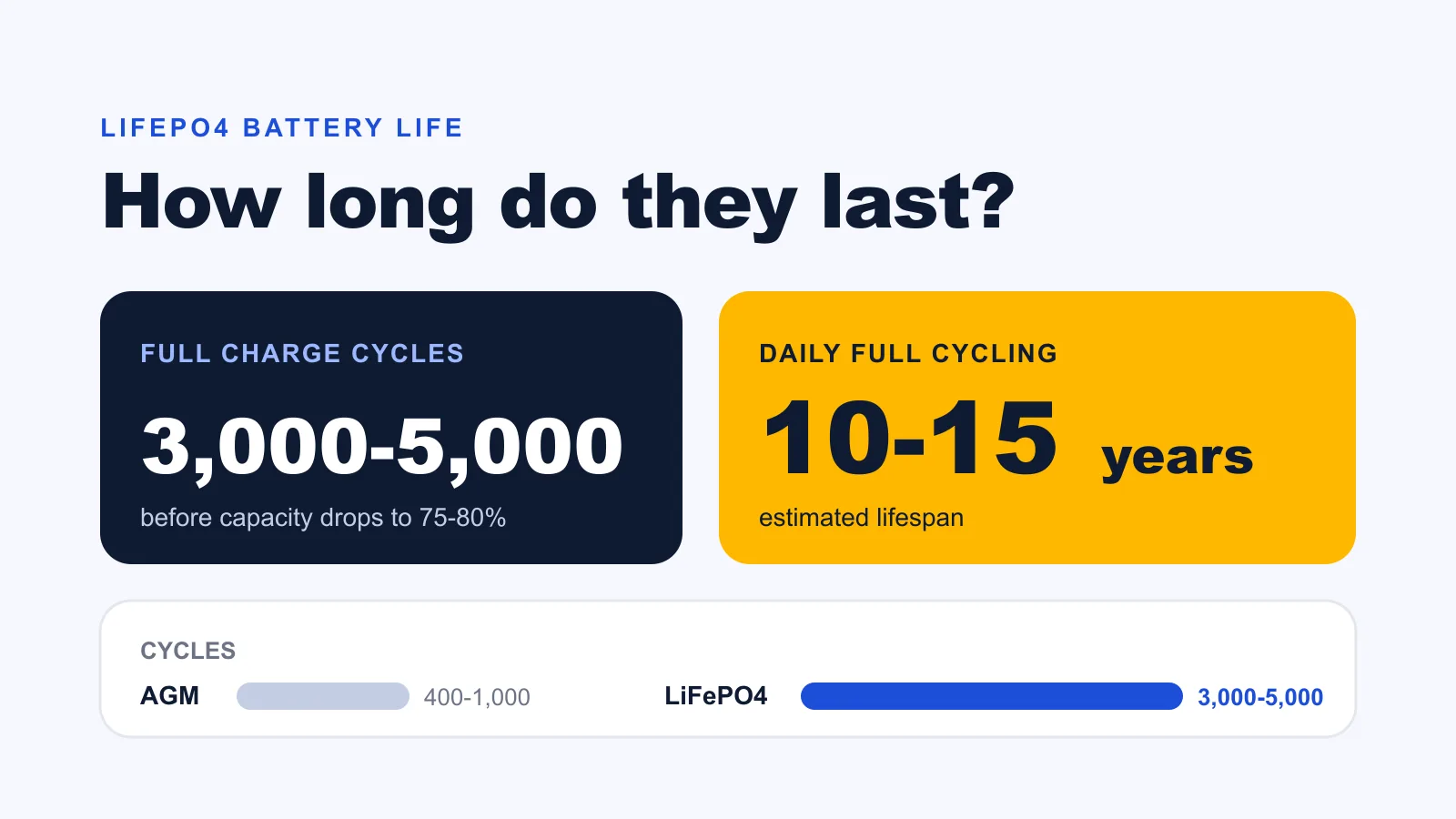
A 100 Ah AGM battery gives only about half of its 1,200 Wh in practice, because lead-acid batteries are usually discharged to no more than about 50 percent. Our guide to LiFePO4 battery life compares the 2 chemistries.
Which voltage should you use?
Use the battery's nominal voltage, the average voltage printed on its label, not the full-charge or empty voltage. For LiFePO4, the nominal voltage is 3.2 V per cell: 12.8 V for a 12 V battery, 25.6 V for 24 V and 51.2 V for 48 V.
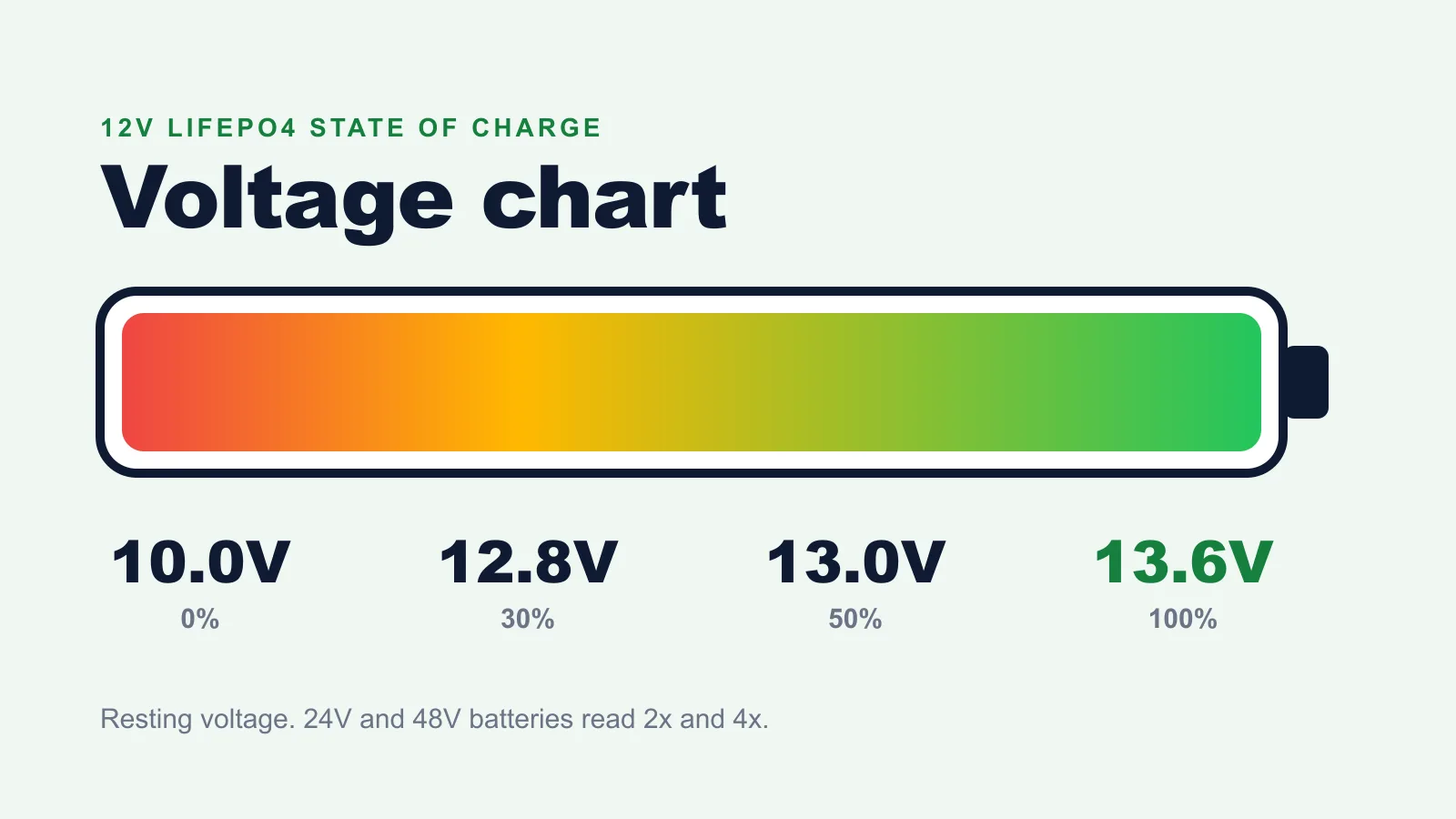
A LiFePO4 battery's actual voltage moves from about 13.6 V full to 10.0 V empty, as our LiFePO4 voltage chart shows. The nominal voltage averages that range, so it gives the right watt-hour figure.
What is the difference between amps and amp-hours?
Amps measure current at one moment, and amp-hours measure how much current flows over time. A device that draws 5 A for 2 hours uses 10 Ah, the same as a device that draws 10 A for 1 hour.
Watts follow the same pattern. Watts (W) measure power at one moment, watts = amps × volts, and watt-hours measure energy over time. A 60 W laptop running for 3 hours uses 180 Wh.
Why compare batteries in watt-hours?
Compare batteries in watt-hours because watt-hours include the voltage, while amp-hours alone do not. A 100 Ah battery at 12 V holds 1,200 Wh, but a 100 Ah battery at 48 V holds 4,800 Wh, 4 times as much energy.
Portable power stations are rated in watt-hours for this reason, and airlines set battery limits in watt-hours: the FAA allows lithium batteries up to 100 Wh in carry-on bags without approval. All 5 picks in our best portable power stations buying guide list their capacity in watt-hours.
How do you turn watt-hours into runtime?
Divide the battery's watt-hours by the device's watts, then multiply by 0.85 to allow for inverter loss. A 1,280 Wh battery runs a 100 W load for about 1,280 ÷ 100 × 0.85 ≈ 11 hours.
The 0.85 factor covers the 10 to 15 percent of energy an inverter loses as heat when it converts battery power to AC. Our guide to how many watt-hours you need works through the sizing for a full overnight power cut.
Common questions
How many watt-hours are in a 48V 100Ah battery?
4,800 Wh at 48 V. A 48 V LiFePO4 battery has a nominal voltage of 51.2 V, so a 100 Ah one holds 5,120 Wh.
How many watts is 20 amps?
It depends on the voltage: watts = amps × volts. 20 A is 2,400 W at 120 V, 4,800 W at 240 V and 240 W at 12 V.
How many amps is 200 watts at 240 volts?
About 0.83 A, because amps = watts ÷ volts and 200 ÷ 240 = 0.83.
Writes guides and reviews for ProductHunter.