Key takeaways
- A portable power station combines a battery, an inverter, a charge controller and outlets in one box.
- It delivers about 85 percent of its rated watt-hours through AC outlets, because the inverter loses 10 to 15 percent as heat.
- Watt-hours decide how long a station runs; continuous watts decide what it can run.
- LiFePO4 stations are rated for 3,000 to 6,000 cycles, about 8 to 16 years of daily cycling.
A portable power station is a rechargeable battery in a carry case with built-in AC outlets, USB ports and a 12 V car socket, used to run devices where there is no wall power. This guide covers the 4 parts inside a power station, how it charges and delivers power, how it differs from a power bank and a gas generator, what a 1,000 Wh station runs, and how many years one lasts.
What is inside a portable power station?
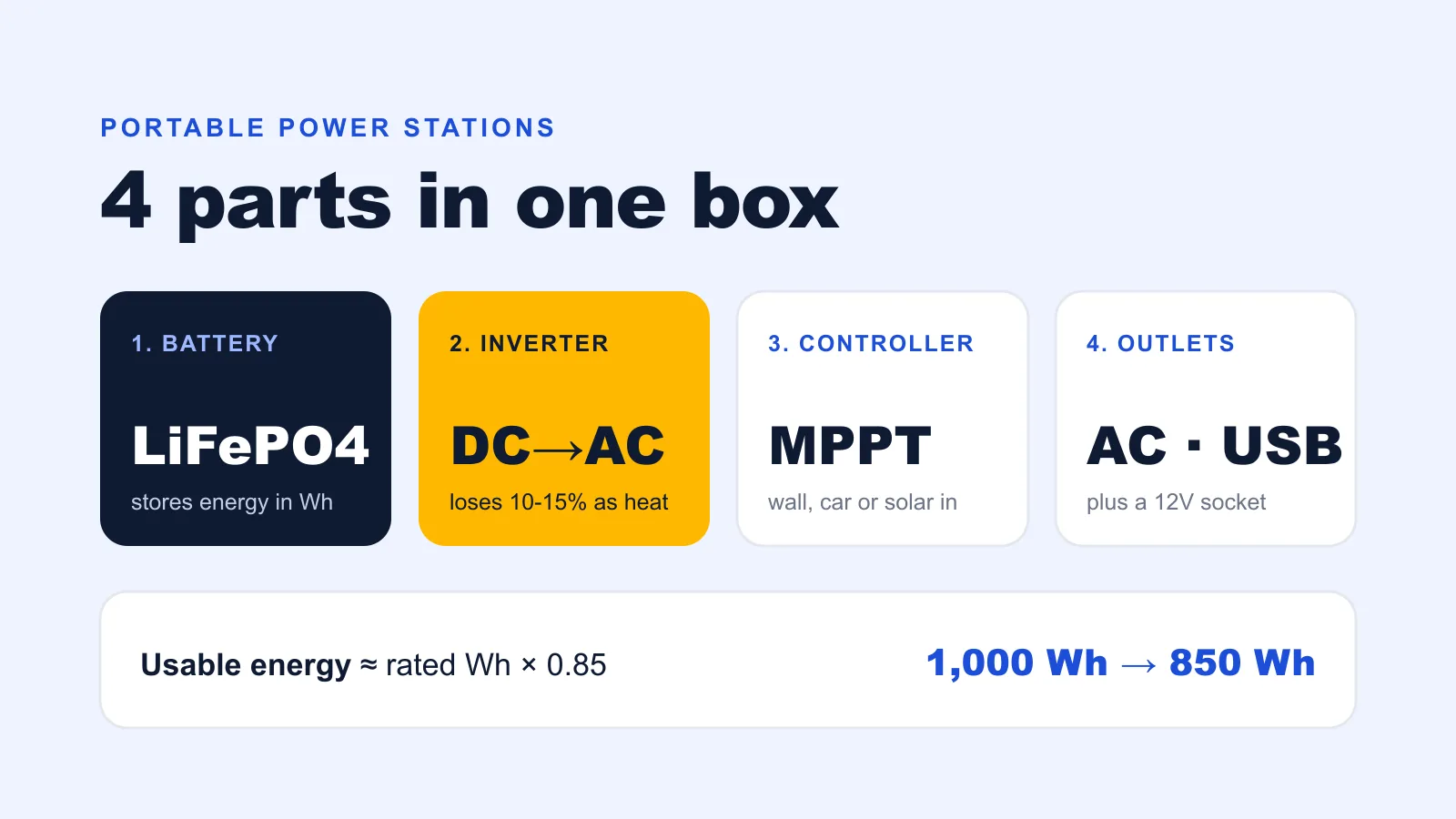
A portable power station holds 4 main parts: a battery that stores energy, an inverter that turns battery power into household AC power, a charge controller that manages incoming power, and a panel of outlets. A battery management system protects all of them.
- Battery. Most current stations use LiFePO4 (lithium iron phosphate) cells, a lithium-ion chemistry known for long cycle life. Capacity is listed in watt-hours (Wh), a unit of energy: 1 Wh runs a 1-watt device for 1 hour.
- Inverter. An inverter converts the battery's direct current (DC) into the alternating current (AC) that wall outlets supply. Its continuous rating in watts sets the largest load the station can run.
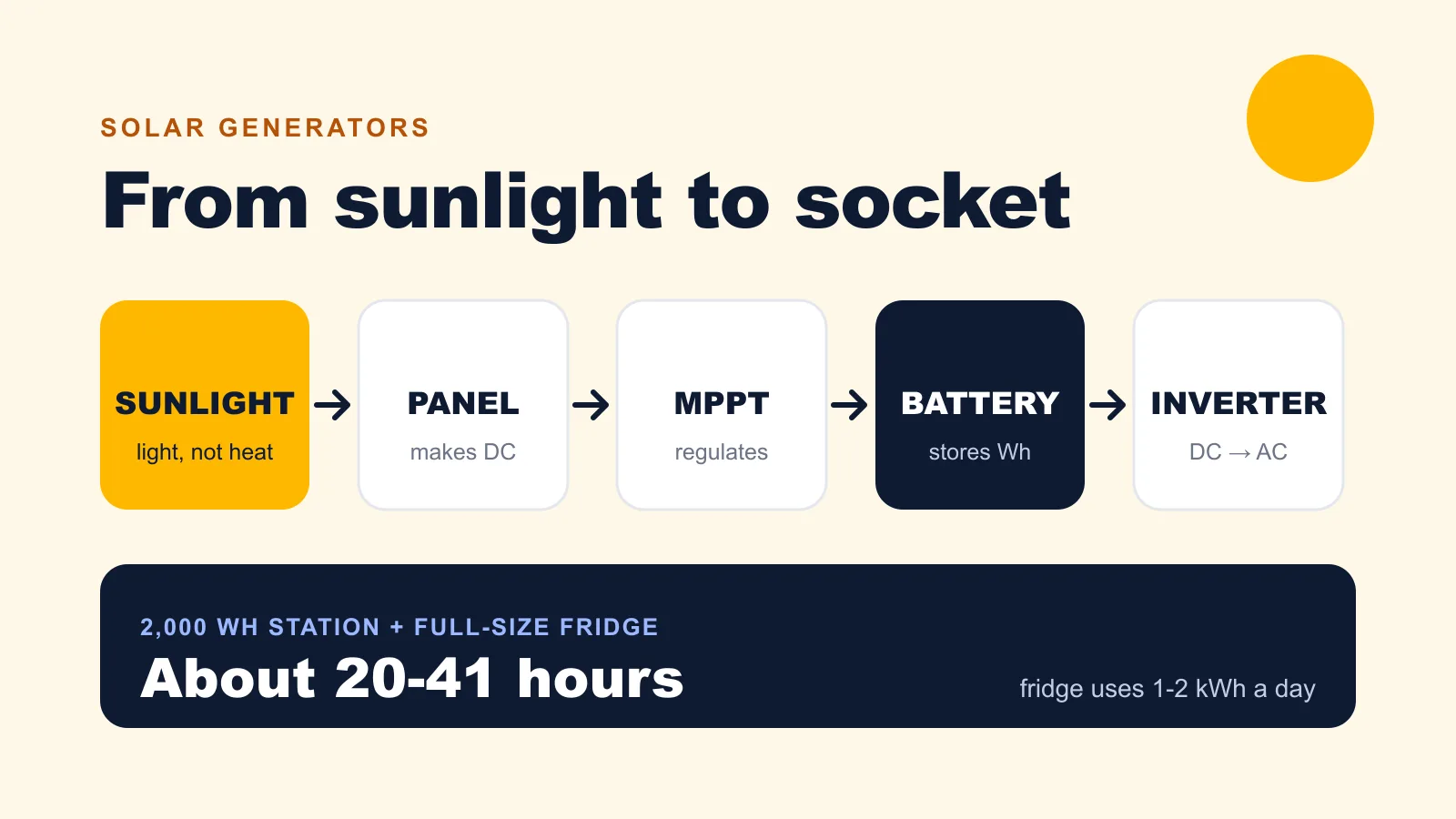
- Charge controller. The charge controller regulates power coming in from a wall charger, a car socket or solar panels so the battery charges safely. Most stations use an MPPT (maximum power point tracking) controller for solar.
- Outlets. AC sockets, USB-C and USB-A ports and a 12 V car socket deliver the stored power. USB and 12 V ports skip the inverter, so they waste less energy.
A battery management system (BMS) is the circuit that watches cell voltage and temperature, and it shuts the station off before the cells overcharge, overheat or drain too far.
How does a portable power station work?
A portable power station works in 2 stages: it stores DC energy in its battery while charging, then releases it through its outlets, converting it to AC on the way to wall-style sockets.
Charging comes from 3 common sources: a wall outlet, a car's 12 V socket or solar panels. Large stations recharge from the wall in about 2 hours. The Jackery HomePower 3000, for example, recharges from a wall outlet in about 2.2 hours, and the EcoFlow DELTA Pro charges at up to 3,000 W.
On the way out, the inverter loses 10 to 15 percent of the energy as heat. That is why a station delivers about 85 percent of its rated watt-hours through its AC outlets. Our guide on how many watt-hours you need explains the full sizing formula.
How is a power station different from a power bank or a generator?
A power station is a large battery with AC outlets, a power bank is a small USB battery for phones and tablets, and a gas generator burns fuel to make electricity on demand.
| Power bank | Portable power station | Gas generator | |
|---|---|---|---|
| Stores energy | Yes, small battery | Yes, large battery | No, burns fuel |
| Typical capacity | Under 100 Wh | A few hundred to over 3,500 Wh | Limited by fuel tank |
| AC outlets | Rarely | Yes | Yes |
| Indoor use | Yes | Yes | No, exhaust fumes |
| Noise | Silent | Silent to fan noise | Engine noise |
A power bank makes sense for a phone on a day trip. A 20,000 mAh power bank at 3.7 V holds 74 Wh, under the FAA's 100 Wh carry-on limit. A power station covers laptops, CPAP machines, lights and refrigerators for hours or days.
What will a 1,000 watt power station run?
A 1,000 W power station runs any device that draws under 1,000 W continuously, including laptops, routers, lights, a CPAP machine and a refrigerator. Its watt-hour capacity, not its watt rating, decides for how long.
These 5 devices fit a station with 1,000 W of continuous output and about 1,000 Wh of capacity:
| Device | Typical draw | Runtime on 1,000 Wh |
|---|---|---|
| Wi-Fi router | 6 to 12 W | About 70 hours at 12 W |
| LED bulb | 8 to 10 W | About 85 hours at 10 W |
| CPAP machine | 30 to 60 W | About 14 hours at 60 W |
| Laptop | 45 to 100 W | About 8.5 hours at 100 W |
| Refrigerator | About 60 W average | About 14 hours |
Each runtime is 1,000 Wh × 0.85 divided by the device's draw. A refrigerator compressor pulls 2 to 3 times its running watts when it starts, so a station needs a surge rating above that peak. An electric kettle at 1,200 to 1,500 W is too much for a 1,000 W station.
How long does a portable power station last?
A portable power station with LiFePO4 cells lasts 3,000 to 6,000 charge cycles before its capacity drops to 70 to 80 percent of new, which is about 8 to 16 years of daily cycling.
Cycle ratings vary by model. The EcoFlow DELTA Pro is rated for 3,500 cycles to 80 percent capacity, the Jackery HomePower 3000 for 4,000 cycles to 70 percent, and the Jackery HomePower 3600 Plus for 6,000 cycles. A station past its rating still works, only for a shorter time per charge. Our guide to how long LiFePO4 batteries last covers the habits that shorten battery life.
Between uses, a station slowly loses charge. Jackery says the HomePower 3000 keeps about 95 percent of its charge after 12 months in storage.
Who needs a portable power station?
A portable power station suits 4 groups of people: households that want backup during power cuts, campers and RV owners, people who rely on medical devices such as a CPAP machine, and anyone working outdoors away from outlets.
Size depends on the job. A unit under 600 Wh covers phones, a laptop and a CPAP for one night. A 1,000 Wh unit runs a refrigerator overnight. Home backup and multi-day outages call for 3,000 Wh or more, with expansion batteries on some models. Our best portable power stations guide compares 5 large LiFePO4 models, and our Pecron review looks at a brand built for camping and backup power.
Common questions
Is a portable power station the same as a generator?
No. A gas generator burns fuel to make electricity, while a portable power station stores electricity in a battery. A power station makes no fumes, so it can run indoors.
Can a portable power station charge from solar panels?
Yes. Most stations have a solar input with a built-in charge controller. A station paired with panels is often sold as a solar generator.
Can you take a portable power station on a plane?
Almost never. The FAA allows lithium batteries up to 100 Wh in carry-on bags, or 100 to 160 Wh with airline approval, and nearly every power station is larger than 160 Wh.
Writes guides and reviews for ProductHunter.