Key takeaways
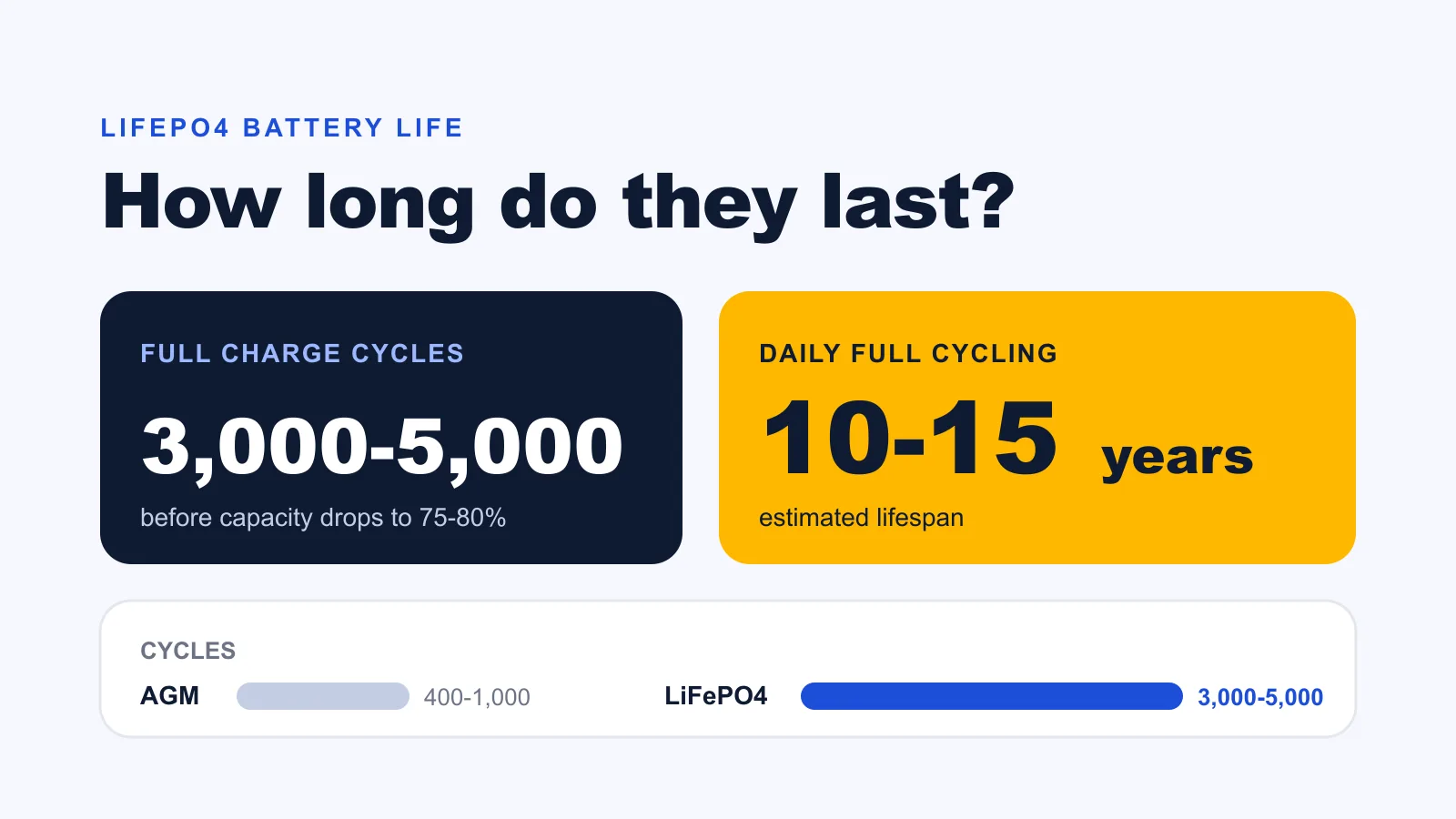
- A LiFePO4 battery keeps 75 to 80 percent of its capacity after 3,000 to 5,000 full cycles.
- Daily full cycling gives a LiFePO4 battery an estimated 10 to 15 years of life.
- Charging below freezing, heat, overcharging and long storage at full charge shorten battery life.
- An AGM battery delivers 400 to 1,000 cycles and only about 50 percent of its rated capacity.
A LiFePO4 battery is a rechargeable lithium-ion battery that uses lithium iron phosphate as its cathode, which gives it a long cycle life and high thermal stability. This guide covers how many years and cycles a LiFePO4 battery lasts, what a charge cycle is, the 4 habits that shorten battery life, how LiFePO4 compares with AGM, the signs a battery is failing, and how to make one last longer.
How long does a LiFePO4 battery last?
A LiFePO4 battery lasts 3,000 to 5,000 full charge cycles before its capacity drops to 75 to 80 percent of new. Battle Born, a US maker of LiFePO4 batteries, estimates 10 to 15 years of life for a battery that is fully cycled every day.
Battle Born rates its 12 V 100 Ah battery at 3,000 to 5,000 cycles and backs it with a 10-year warranty. The battery keeps working after that point. A battery at 75 percent capacity still runs the same devices, only for a shorter time.
What counts as a charge cycle?
A charge cycle is one full discharge and recharge of the battery's rated capacity. Two half discharges add up to one cycle, so a battery used to 50 percent twice uses one cycle, not two.
LiFePO4 batteries tolerate discharges to nearly 100 percent of their capacity, cycle after cycle, without the damage deep discharges cause in lead-acid batteries. That means the full rated capacity is usable in daily use.
What shortens LiFePO4 battery life?
4 habits shorten the life of a LiFePO4 battery: charging below freezing, heat, overcharging and long storage at full charge.
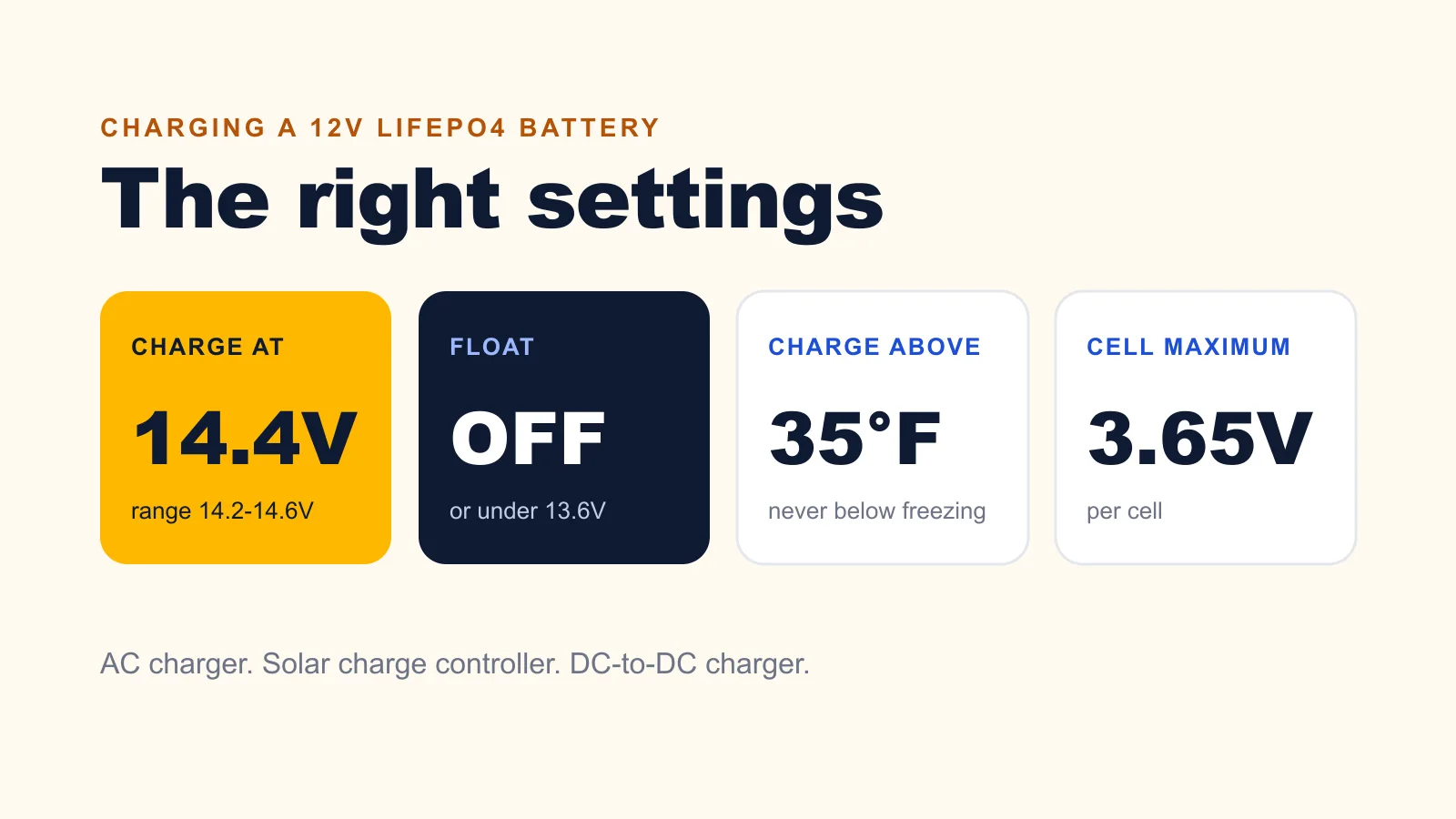
- Charging below freezing. Battle Born says its batteries need to stay above 35°F (about 2°C) to charge safely. Most battery management systems (BMS), the circuit that protects the cells, block charging below 32°F (0°C). Heated batteries warm their cells before charging.
- Heat. Battery maker comparisons report that LiFePO4 cycle life falls by 20 to 30 percent at 45°C (113°F) compared with 25°C (77°F).
- Overcharging. A LiFePO4 cell must not exceed 3.65 V, which is 14.6 V for a 12 V battery. Chargers set for lead-acid or other lithium chemistries push the cells past that limit.
- Storage at full charge. LiFePO4 makers recommend storing a battery at roughly 50 percent charge for months-long storage, because long periods at full voltage age the cells faster.
How does LiFePO4 life compare with AGM?
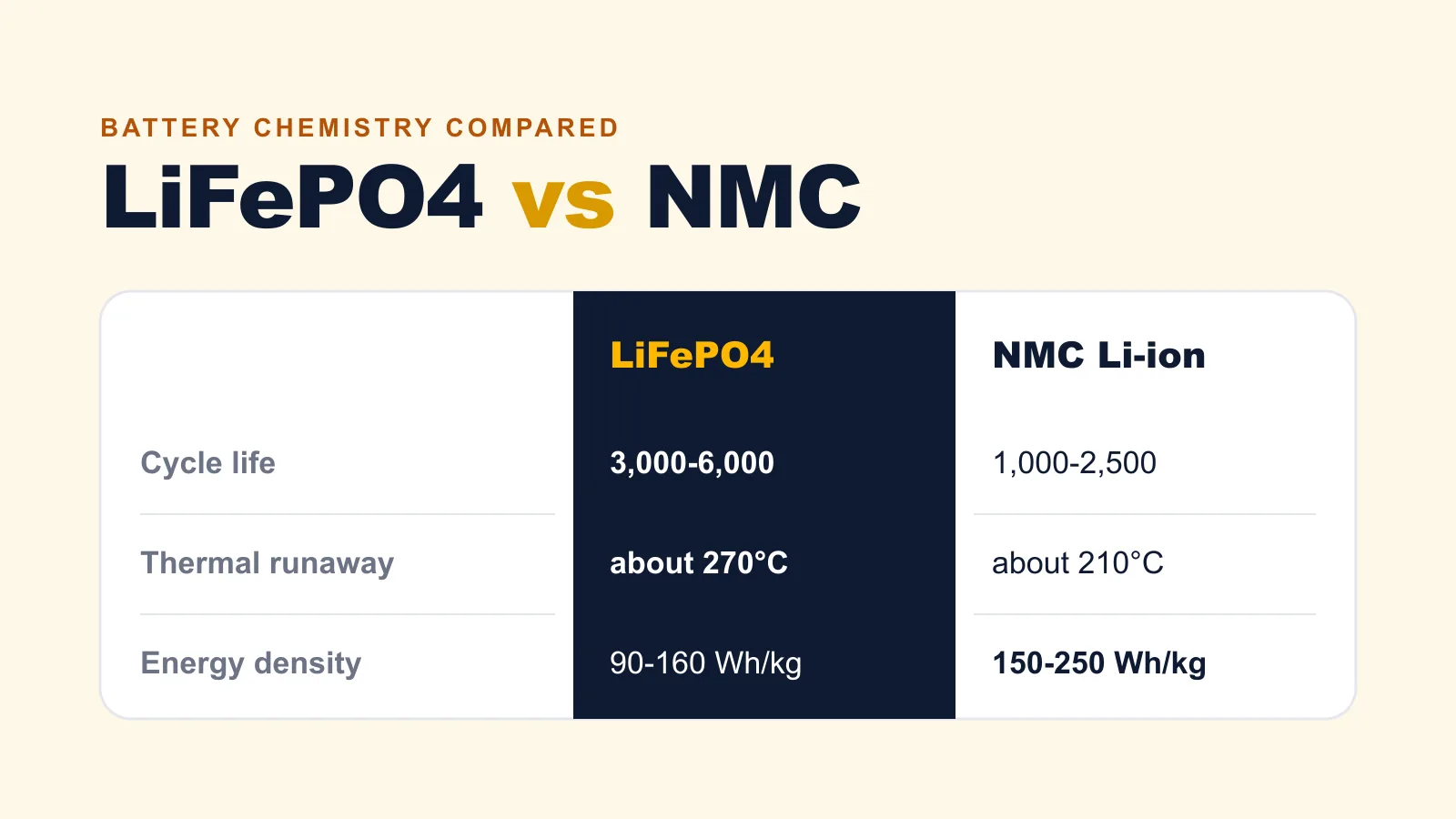
A LiFePO4 battery lasts 3 to 10 times as many cycles as an AGM battery and lets you use more of its capacity. AGM is a sealed lead-acid battery type, rated for 400 to 1,000 cycles depending on how deeply it is discharged.
| LiFePO4 | AGM (lead-acid) | |
|---|---|---|
| Cycle life | 3,000 to 5,000 | 400 to 1,000 |
| Usable capacity | Nearly 100% | About 50% |
| Float charge needed | No | Yes |
| Holds charge when idle | Loses 1 to 3% per month | Loses charge quickly off the charger |
Lead-acid and AGM batteries are usually limited to about 50 percent depth of discharge to protect their life, so a 100 Ah AGM battery gives about 50 Ah of usable energy. A 100 Ah LiFePO4 battery gives nearly all 100 Ah.
How do you know if a LiFePO4 battery is bad?
A LiFePO4 battery is failing when it runs a known load for much less time than it did when new. A runtime below about 75 percent of the original marks the end of its rated life.
4 signs point to a failing battery:
- Shorter runtime. The same device runs for noticeably fewer hours on a full charge.
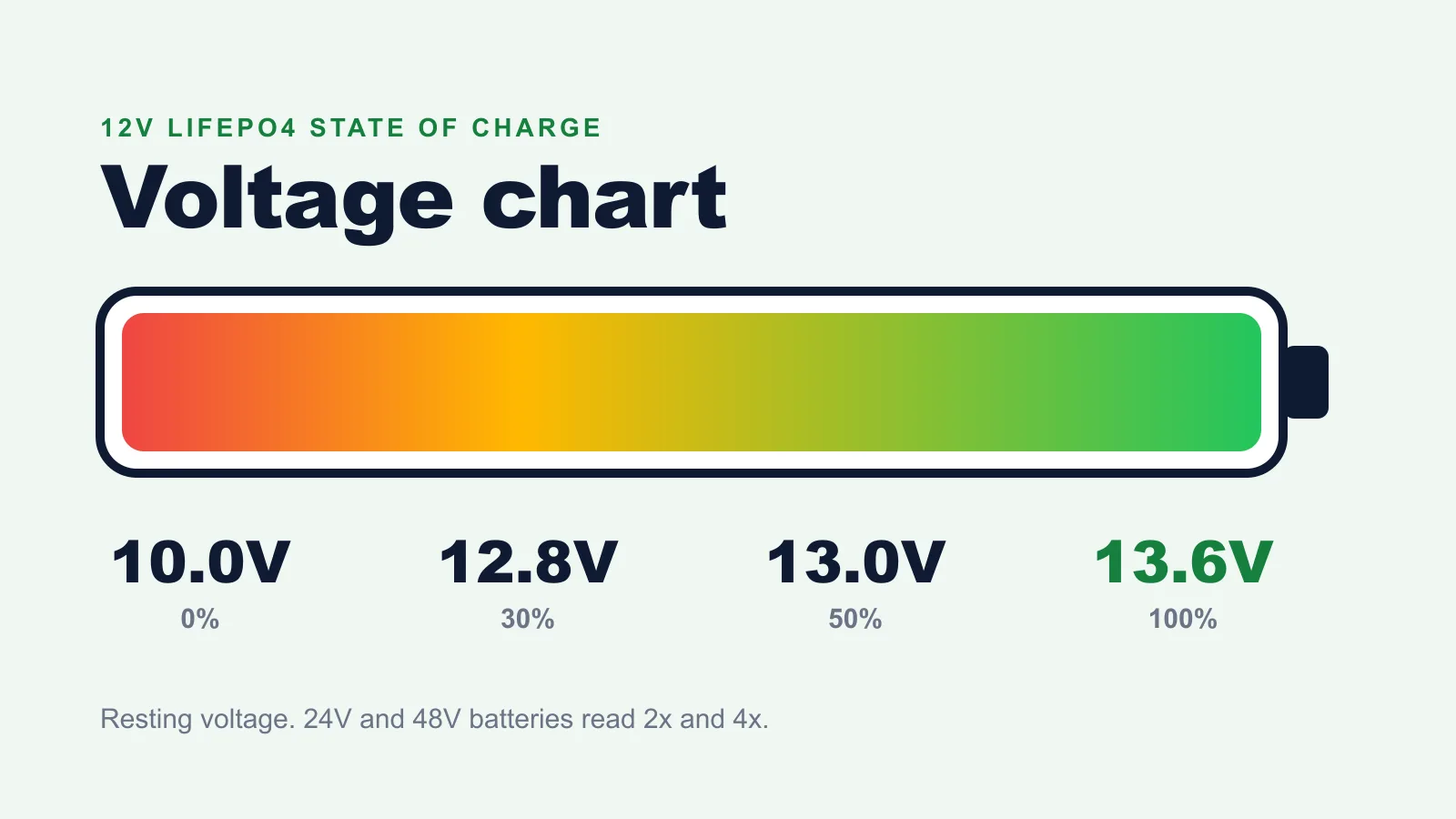
- Low resting voltage. A 12 V battery that rests well below 13.4 V right after a full charge, or that drops fast under light loads, has lost capacity. Our LiFePO4 voltage chart shows what each voltage means.
- BMS shutdowns. The battery cuts out under loads it handled before, because weak cells hit their low-voltage limit early.
- Swelling, heat or smell. Any physical change means the battery should be disconnected and taken out of use.
How can you make a LiFePO4 battery last longer?
Make a LiFePO4 battery last longer by charging it with a LiFePO4 profile, keeping it out of extreme heat and cold, and storing it half full. These 5 habits protect the cells:
- Charge at 14.2 to 14.6 V for a 12 V battery, the range Battle Born gives. Our guide on how to charge a LiFePO4 battery covers chargers, solar and alternators.
- Never charge below freezing unless the battery has a built-in heater.
- Keep the battery between about 10°C and 35°C (50°F and 95°F) where you can.
- Turn float charging off, or keep it under 13.6 V.
- Store the battery at about 50 percent charge and check it every 3 months.
All 5 picks in our best portable power stations buying guide use LiFePO4 cells, rated for 3,500 to 6,000+ cycles, and our Vatrer Power LiFePO4 battery review looks at deep-cycle batteries for RVs and off-grid setups.
Common questions
Is it OK to leave a LiFePO4 battery on the charger?
Yes, if the charger uses a LiFePO4 profile. Battle Born says a LiFePO4 battery needs no float charge and that a float voltage under 13.6 V is fine for a 12 V battery.
Does a LiFePO4 battery lose charge when not in use?
Yes, slowly. LiFePO4 makers list self-discharge of about 1 to 3 percent per month, and the rate rises in hot storage.
Do LiFePO4 batteries have a memory effect?
No. A LiFePO4 battery does not need full discharges to keep its capacity, so partial charges and top-ups are fine.
Writes guides and reviews for ProductHunter.