Key takeaways
- A solar generator is a portable power station recharged by solar panels; it stores energy rather than generating it on demand.
- Solar panels make electricity from light, not heat, and lose about 0.3 to 0.5 percent of output for every degree Celsius above 25°C.
- A station's maximum solar input caps charging speed, so extra panel watts above it go unused.
- A 2,000 Wh solar generator runs a full-size refrigerator for about 20 to 41 hours on one charge.
A solar generator is a portable power station paired with solar panels: the panels turn sunlight into electricity, and the station stores it in a battery and delivers it through AC outlets and USB ports. This guide covers the 4 steps from sunlight to socket, how solar panels make electricity, how a solar generator differs from a gas generator, how long one runs a refrigerator, how long the panels take to recharge it, and what the 33% rule means.
How does a solar generator work, step by step?
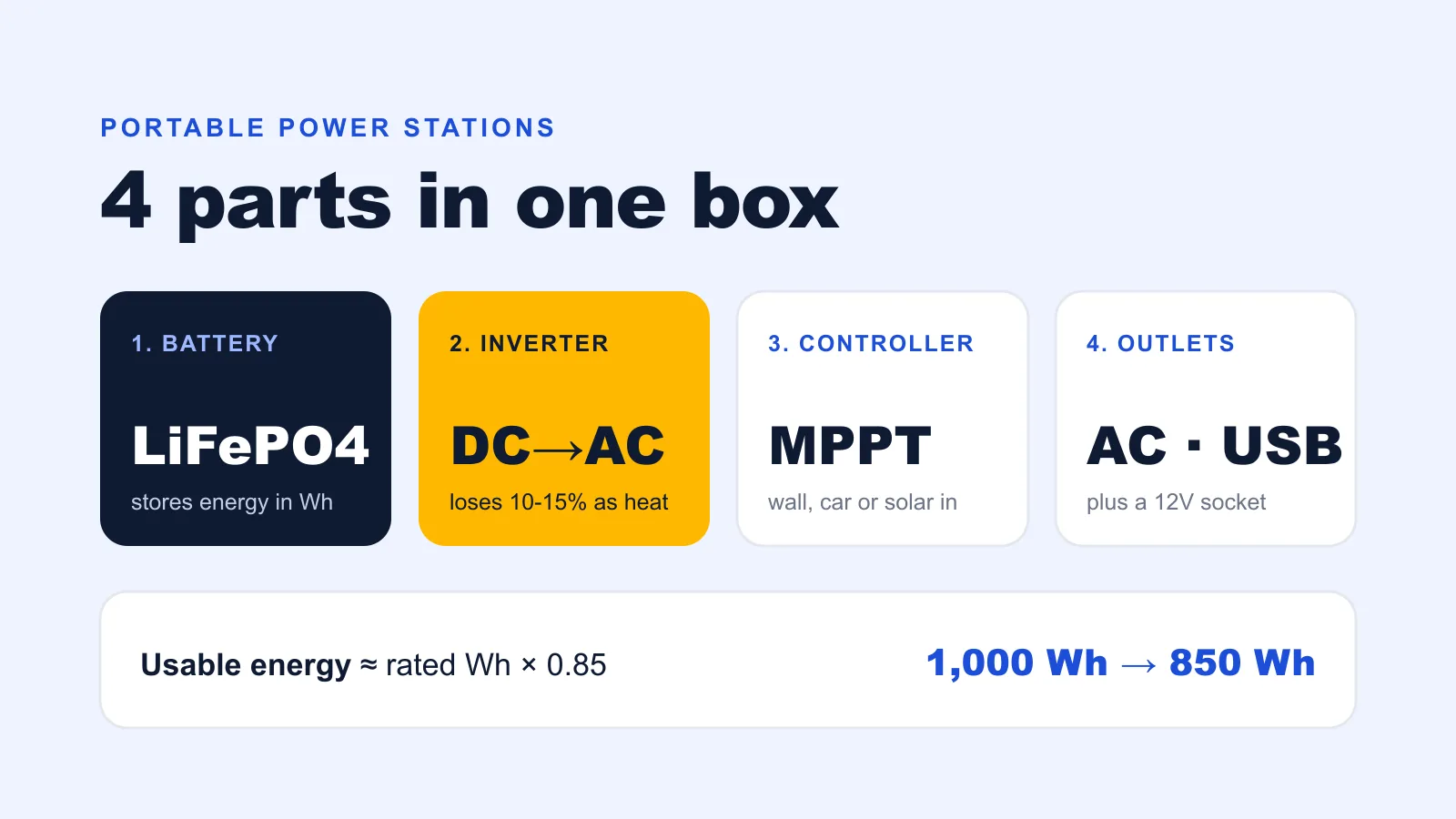
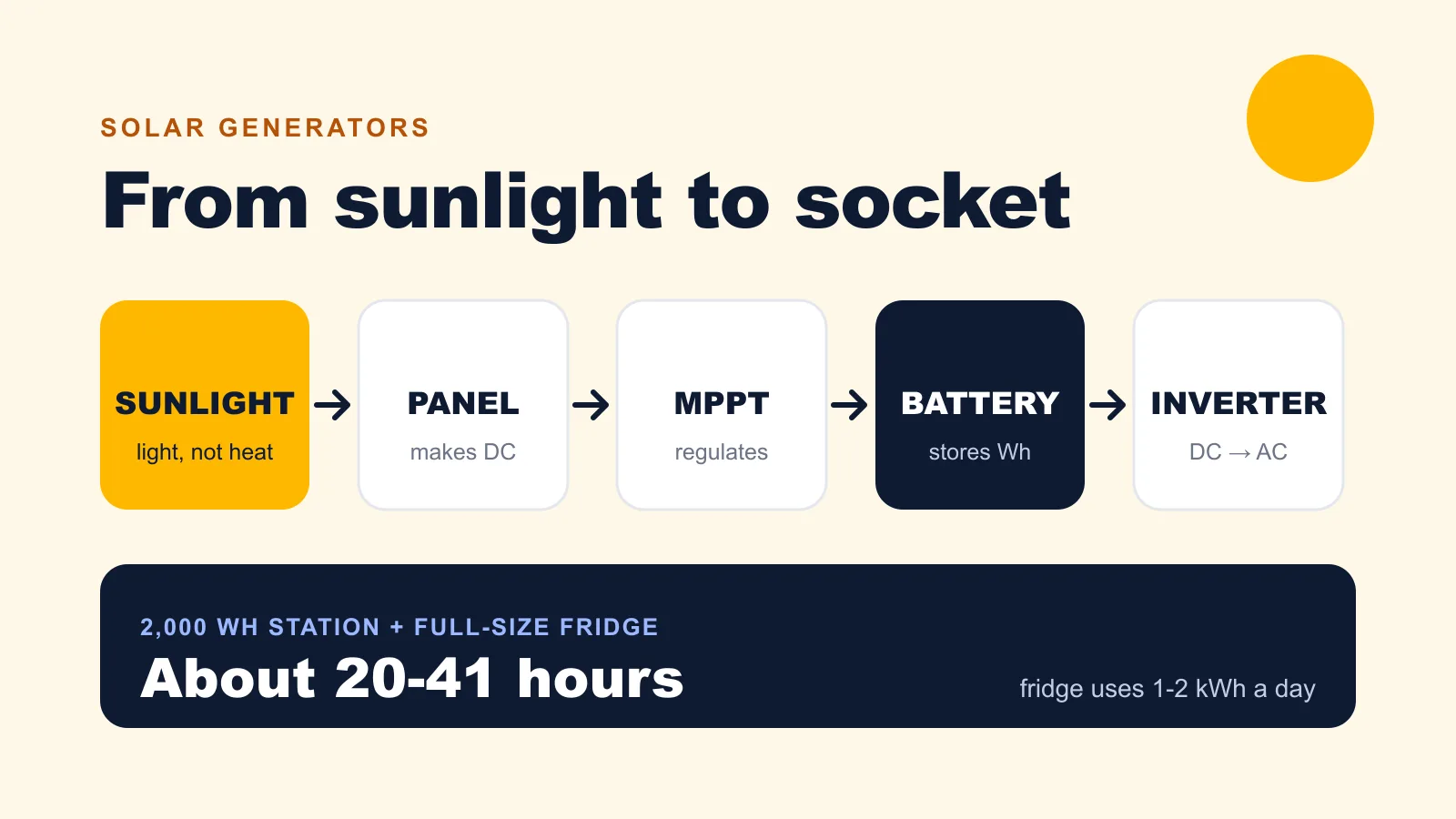
A solar generator works in 4 steps: panels convert sunlight into DC electricity, a charge controller regulates it, a battery stores it, and an inverter turns it into AC power for household devices.
- Solar panels capture light. Photovoltaic (PV) cells, usually made of silicon, release electrons when light hits them. The result is direct current (DC) electricity.
- The charge controller regulates it. An MPPT (maximum power point tracking) charge controller constantly adjusts voltage and current to draw the most power the panels can give, and it protects the battery from overcharging. It is built into the power station.
- The battery stores it. Most current solar generators use LiFePO4 (lithium iron phosphate) batteries, rated in watt-hours (Wh).
- The inverter delivers it. An inverter converts the battery's DC into alternating current (AC) for wall-style outlets. USB and 12 V ports use DC directly and skip the inverter.
The word "generator" is borrowed from gas generators. A solar generator stores energy and releases it later; it does not create power on demand. Our guide on what a portable power station is covers the station itself in more detail.
Do solar panels make electricity from heat or light?
Solar panels make electricity from light, not heat. Heat actually lowers their output: a typical panel loses about 0.3 to 0.5 percent of its power for every degree Celsius its cells run above 25°C.
Panel ratings in watts are measured at standard test conditions (STC): 1,000 watts of sunlight per square metre with the cells at 25°C (77°F). Panels on a hot roof run far hotter than 25°C, so they produce less than their rating in summer heat. Cold, sunny days help them, because the same temperature coefficient raises output below 25°C.
How is a solar generator different from a gas generator?
A solar generator stores energy from the sun in a battery and runs silently with no fumes, while a gas generator burns fuel to make electricity on demand and runs as long as it has fuel.
| Solar generator | Gas generator | |
|---|---|---|
| Energy source | Sunlight, wall or car charging | Gasoline, propane or diesel |
| Indoor use | Yes | No, exhaust contains carbon monoxide |
| Noise | Silent to fan noise | Engine noise |
| Runtime | Limited by battery and sun | As long as there is fuel |
| Maintenance | Almost none | Oil changes, fuel storage |
A gas generator suits long outages with heavy loads. A solar generator suits camping, RVs and short outages, and it recharges every sunny day without fuel.
How long will a 2,000 Wh solar generator run a fridge?
A 2,000 Wh solar generator runs a full-size refrigerator for about 20 to 41 hours on one charge. A full-size fridge uses 1 to 2 kWh per day, and the station delivers about 85 percent of its rated capacity through AC outlets.
The calculation takes 3 steps:
- Usable energy: 2,000 Wh × 0.85 = 1,700 Wh.
- A fridge using 2 kWh per day draws about 83 Wh per hour, so 1,700 Wh lasts about 20 hours.
- A fridge using 1 kWh per day draws about 42 Wh per hour, so 1,700 Wh lasts about 41 hours.
Solar panels stretch that time. Every hour of good sun puts energy back into the battery while the fridge runs. The station also needs at least 1,000 W of continuous output, because a compressor pulls 2 to 3 times its running watts when it starts. Our guide on how many watt-hours you need lists the draw of 7 common devices.
How long do solar panels take to recharge a solar generator?
Solar panels take the battery's watt-hours divided by the panel watts, in peak sun hours, to recharge a solar generator in the best case. A 2,000 Wh battery on 400 W of panels needs about 5 peak sun hours.
A peak sun hour is one hour of sunlight at 1,000 watts per square metre, the same intensity used to rate panels. A day's weaker morning and evening light adds up to a smaller number of peak sun hours, often between about 4 and 6 in much of the US. Real charging is slower than the best case because of heat, clouds, shade and panel angle.
The station's maximum solar input caps charging speed. The Jackery HomePower 3600 Plus accepts up to 1,000 W of solar, the EcoFlow DELTA Pro 1,600 W, and the BLUETTI Apex 300 up to 2,400 W. Panels above that limit add nothing.
What is the 33% rule in solar panels?
The 33% rule usually refers to rooftop fire-safety codes that limit home solar panels to about a third of a roof's area before extra setbacks for firefighter access apply. It does not apply to portable solar generators.
Installers also use the phrase for sizing a home inverter: panel capacity up to about 133 percent of the inverter's rating, because panels rarely produce their full rated power. For a portable solar generator, the limit that matters is the station's maximum solar input. Our best portable power stations guide lists the solar input of 5 LiFePO4 models, and our ACOPower review covers a brand that sells stations and solar panels together.
Common questions
Can a solar generator run a house?
Only part of one. Large units with 3,000 Wh or more and expansion batteries run essentials such as a refrigerator, lights and a router. Some, like the Jackery HomePower 3000, connect to a manual transfer switch for up to 6 home circuits.
Do solar generators work on cloudy days?
Yes, but slowly. Clouds cut the sunlight reaching the panels, so charging takes much longer. The stored battery power works the same in any weather.
Is a solar generator the same as a portable power station?
Nearly. A solar generator is a portable power station sold or used with solar panels. The station holds the battery, inverter and charge controller; the panels recharge it.
Writes guides and reviews for ProductHunter.