
Key takeaways
- Watt-hours needed = the sum of (device watts × hours of use), divided by 0.85.
- A fridge, laptop, router and lights overnight need about 1,100 Wh.
- Continuous output in watts decides what a station can run; watt-hours decide for how long.
- Airlines allow batteries up to 100 Wh in carry-on bags without approval.
A watt-hour (Wh) is a unit of energy that measures how much power a battery delivers over time: 1 Wh runs a 1-watt device for one hour. Sizing a portable power station means adding up the watt-hours your devices use and allowing for the energy the station loses converting DC power to AC. This guide covers the formula, the draw of 7 common devices, a sizing table by use, and the difference between running and surge watts.
How do you calculate the watt-hours you need?
Add the watts of each device multiplied by its hours of use, then divide the total by 0.85. The 0.85 factor covers inverter loss, because a power station's inverter loses 10 to 15 percent of stored energy as heat when it converts battery DC power to AC power.
Sizing a power station takes 3 steps:
- List every device and its running watts, from the label or the charger.
- Multiply each device's watts by the hours you will run it.
- Add the results and divide the total by 0.85.
USB-C devices lose less energy than AC devices, so the 0.85 factor slightly overestimates the needs of phones and laptops charged over USB-C.
How much power do common devices use?
Common household devices draw between 6 W and 1,500 W while running. The table lists typical running figures for 7 devices; the label on the device or its charger gives the exact number.
| Device | Typical draw | Note |
|---|---|---|
| Phone | 10–20 Wh per full charge | Battery capacity, not continuous draw |
| Laptop | 45–100 W | Lower when idle |
| Wi-Fi router | 6–12 W | Runs continuously |
| LED bulb | 8–10 W | Per bulb |
| CPAP machine | 30–60 W | Up to 90 W with a heated humidifier |
| Full-size refrigerator | 1–2 kWh per day | Compressor cycles on and off |
| Electric kettle | 1,200–1,500 W | Runs for minutes, not hours |
How many watt-hours does an overnight power cut need?
An overnight power cut needs about 1,100 Wh for a refrigerator, a laptop, a router and two LED bulbs. The calculation for 10 hours is:
- Refrigerator: 60 W average × 10 h = 600 Wh
- Laptop: 60 W × 3 h = 180 Wh
- Wi-Fi router: 10 W × 10 h = 100 Wh
- Two LED bulbs: 20 W × 5 h = 100 Wh
- Phone charging: 15 W × 1.5 h = 23 Wh
The total is 1,003 Wh, and 1,003 Wh divided by 0.85 equals 1,180 Wh. A 1,000 to 1,200 Wh power station covers this list.
What is the difference between running watts and surge watts?
Running watts are the continuous power a station delivers, and surge watts are the short peak it delivers for a fraction of a second.
A refrigerator compressor or a power tool pulls 2 to 3 times its running watts when it starts. A station whose surge rating is below that peak shuts off even with a full battery, so a refrigerator needs a station with at least 1,000 W of continuous output.
Which power station size fits which job?
Power station capacity falls into 4 size classes, from under 600 Wh for one night of electronics to over 3,000 Wh for home backup.
| Capacity | Runs | Example |
|---|---|---|
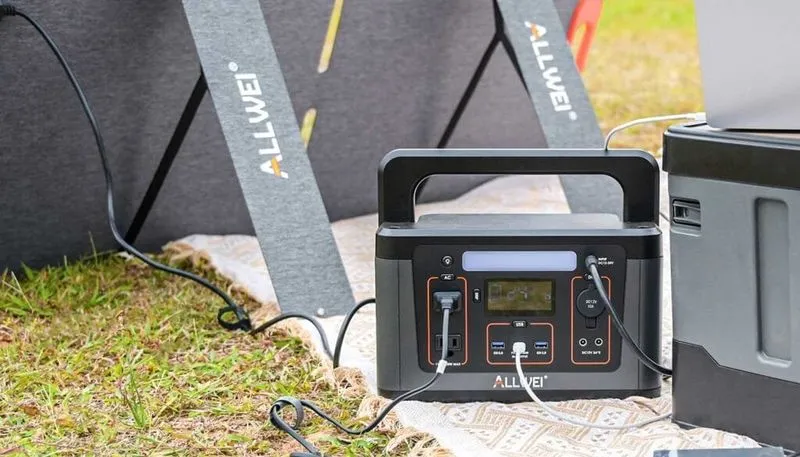
| Up to 600 Wh | Phones, a laptop, lights and a CPAP for one night | ALLWEI PPS600 |
| About 1,000 Wh | A refrigerator overnight and short power cuts | ACOPOWER P1000 PLUS |
| About 2,000 Wh | A full day of essentials and RV trips | FOSSiBOT F2400 |
| 3,000 Wh and up | Multi-day outages, power tools and home backup | FOSSiBOT F3600 Pro |
Why does a power station deliver less than its rated capacity?
A power station delivers about 85 percent of its rated capacity through its AC outlets because of 2 losses: inverter heat and a protected battery reserve.
First, the inverter converts DC to AC and loses 10 to 15 percent as heat. Second, the battery management system keeps a small reserve to protect the cells, so the last few percent on the display are not usable. Cold temperatures and battery age reduce usable capacity further, so a 20 percent margin on top of the calculated figure prevents a station from running out early.
Common questions
Is mAh the same as Wh?
No. mAh measures charge, and Wh measures energy. Multiply mAh by the battery voltage and divide by 1,000 to get Wh. A 20,000 mAh power bank at 3.7 V holds 74 Wh.
Can a 500 Wh power station run a refrigerator?
No, not for long. A full-size refrigerator uses 1 to 2 kWh per day, and most 500 Wh stations have under 1,000 W of continuous output, which is too little to start a compressor.
Can I take a power station on a plane?
Only very small ones. The FAA allows lithium batteries up to 100 Wh in carry-on bags without approval and 100 to 160 Wh with airline approval. Almost every power station is larger than 160 Wh.
Writes guides and reviews for ProductHunter.