Key takeaways
- Blue light therapy uses wavelengths of about 400 to 470 nm and reaches less than 1 mm into the skin, the top layer called the epidermis.
- Red light therapy uses about 630 to 700 nm and reaches 2 to 3 mm deep, where it may stimulate collagen.
- Blue light is mainly used for acne and, with a light-sensitising drug, for precancerous actinic keratoses; red light is promoted for wrinkles, scars and redness.
- The American Academy of Dermatology lists blue, red and blue + red devices as able to treat pimples, but light alone rarely clears acne.
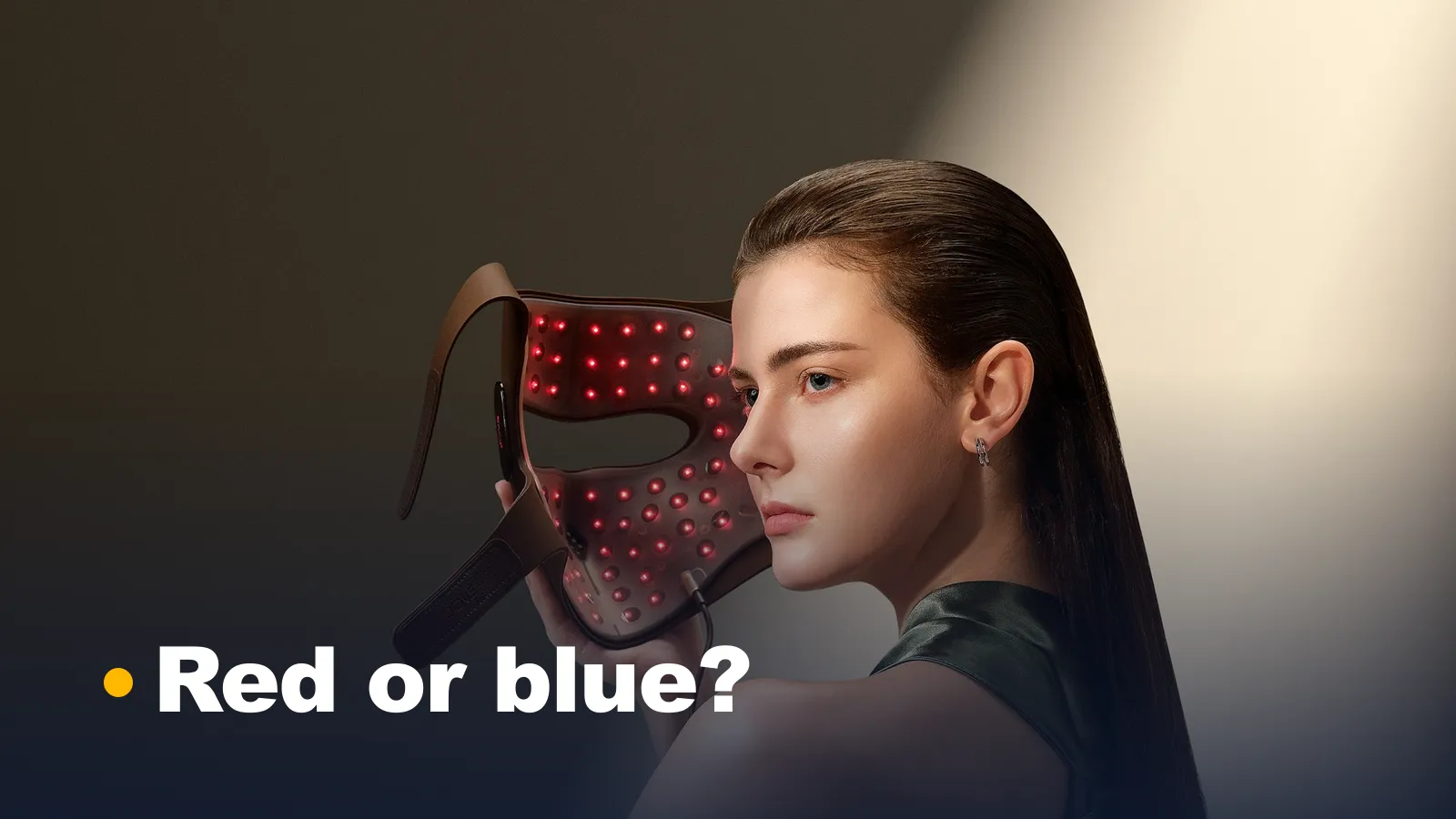
Red light therapy and blue light therapy are 2 types of light-emitting diode (LED) treatment that shine a single colour of light on the skin, and the main difference is depth: blue light acts on the surface, red light goes deeper. This guide compares their wavelengths, what each treats, using them together, safety, and how many sessions each takes.
What is the difference between red and blue light therapy?
The difference is wavelength and depth: blue light uses about 400 to 470 nm and reaches less than 1 mm into the epidermis, the top skin layer, while red light uses about 630 to 700 nm and reaches 2 to 3 mm deep.
A nanometre (nm) is one billionth of a metre, the unit used to measure the wavelength of light. Longer wavelengths travel deeper into the skin, so each colour reaches a different layer.
| Light | Wavelength | Depth in skin | Main target |
|---|---|---|---|
| Blue | 400 to 470 nm | Less than 1 mm | Acne bacteria on the surface |
| Yellow | 570 to 590 nm | 0.5 to 2 mm | Upper dermis |
| Red | 630 to 700 nm | 2 to 3 mm | Deeper skin structures |
| Infrared | 800 to 1,200 nm | 5 to 10 mm | Deepest layers |
Figures from a review of LED treatments in the Journal of Clinical and Aesthetic Dermatology. Devices commonly use peaks of 415 nm for blue and 633 nm for red.
How does each light work?
Each colour works on a different target. Blue light kills acne bacteria, and red light is thought to act on the mitochondria, the energy-producing parts of cells.
- Blue light. The acne bacterium (Cutibacterium acnes, formerly P. acnes) makes its own light-sensitive compound, which makes it vulnerable to blue wavelengths, according to Cleveland Clinic.
- Red light. By acting on mitochondria, red light may stimulate collagen, the protein that gives skin its structure, and fibroblasts, the cells that make collagen.
What does each one treat?
Blue light is used mainly for acne and sun damage, while red light is promoted mainly for signs of aging and scarring. Cleveland Clinic says there isn't enough evidence yet to support most red light uses.
| Blue light | Red light | |
|---|---|---|
| Main uses | Acne, sun damage, actinic keratoses (with a drug) | Wrinkles, fine lines, scars, redness, acne, stretch marks |
| Also used for | Some non-melanoma skin cancers (with a drug) | Hair growth in androgenic alopecia, rosacea, psoriasis |
| Doesn't treat | Acne cysts, blackheads, whiteheads | Weight loss, cellulite, depression (no evidence) |
Actinic keratoses (AKs) are rough, scaly precancerous patches caused by sun damage. Doctors treat them with photodynamic therapy (PDT): a light-sensitising drug, most often 5-aminolevulinic acid (ALA), soaks into the skin and is then activated by blue or red light. The American Academy of Dermatology (AAD) says the drug stays on for about 60 to 90 minutes before the light is applied.
Our guide to whether red light therapy works explains the evidence for each red light claim in detail.
Can you use red and blue light together?
Yes. The AAD lists blue, red and blue + red light devices as able to treat pimples, and says the FDA has approved some of them for use at home.
In one open-label study, 24 people with mild to moderate acne alternated 415 nm blue and 633 nm red light, 20 minutes each, twice a week for 4 weeks. Inflammatory lesions improved by 77.9% and non-inflammatory lesions by 34.2%. The study had no control group, and the AAD says light treatments rarely clear acne on their own.
Which is safer, red or blue light?
Both have few side effects when used as directed. Red light appears to have no side effects in short-term use, while blue light for acne can cause redness or dry skin, according to Cleveland Clinic.
Photodynamic therapy carries more side effects because of the drug: sunburn-like redness, sensitivity to the sun for 2 to 3 days, then flaking and peeling over about a week. The AAD says to avoid daylight for 48 hours after PDT.
3 groups should avoid LED light therapy, according to Cleveland Clinic:
- People taking medicines that make the skin sensitive to light, such as isotretinoin or lithium.
- People with a history of skin cancer.
- People with an inherited eye disease.
Always wear goggles. Our guide to FDA-cleared red light devices explains what the FDA label on a home device means.
How many sessions does each take?
Red light therapy in a clinic usually takes 1 to 3 sessions a week for weeks or months, according to Cleveland Clinic. Office LED treatment for acne often runs about once a week for about a month.
At-home devices are weaker than office devices, so they need more frequent use, sometimes twice a day for several weeks, following the device's directions. Cleveland Clinic says home masks are unlikely to give dramatic results, and it can take several sessions to tell if your acne responds to blue light. Our Omnilux LED review and Infraredi LED mask review cover 2 home devices.
Common questions
Is red or blue light better for acne?
Blue light is the main acne light because it kills the acne bacteria, while red light may calm inflammation. The American Academy of Dermatology lists blue, red and combined blue + red devices as able to treat pimples.
Can you use red and blue light therapy together?
Yes. Many devices combine both, and in one open-label study 24 people with mild to moderate acne who alternated blue and red light twice a week for 4 weeks saw inflammatory spots improve by 77.9%.
How do you do red light therapy at home?
Start with a clean, makeup-free face, wear goggles or sunglasses, follow the device's directions and limit sun afterwards. Cleveland Clinic advises choosing a device labelled FDA cleared or FDA approved and checking with a dermatologist first.
Does blue light therapy work on blackheads?
No. Cleveland Clinic says blue light doesn't treat acne cysts, blackheads or whiteheads; it works on inflamed pimples.
Writes guides and reviews for ProductHunter.