Key takeaways
- Apple Watch tracks sleep with its accelerometer, sorting every 30 seconds into Awake, REM, Core or Deep sleep.
- In Apple's validation against a sleep lab, the watchOS 26 algorithm detected 96.8% of sleep and 78.9% of time awake.
- Sleep Score rates each night from 0 to 100: 50 points for duration, 30 for bedtime consistency and 20 for interruptions.
- Charge the watch to at least 30% before bed, or sleep may not be tracked.
Apple Watch sleep tracking is a built-in feature that records when you sleep, how long, and how much time you spend in each sleep stage, using motion sensors on your wrist. This guide covers how to set it up, how it works, what it measures, how accurate it is against a sleep lab, and how the Sleep Score works.
How do you turn on sleep tracking on Apple Watch?
You turn it on in the Health app on your iPhone, then wear the watch to bed for at least 1 hour. Apple's setup takes 3 steps:
- Open the Health app on your iPhone.
- Tap Get Started under Set Up Sleep, then tap Next.
- Follow the prompts to set your sleep goal, bedtime and wake-up times, Sleep Focus, and Track Sleep with Apple Watch.
Sleep Focus is a mode that simplifies your Lock Screen and silences distractions at bedtime. To change your schedule later, go to Health > Browse > Sleep > Sleep, pick a schedule under Full Schedule & Options, and tap Edit.
How does Apple Watch track sleep?
Apple Watch tracks sleep with its accelerometer, a motion sensor that picks up both large movements and the small motions of breathing. Apple's algorithm sorts every 30 seconds of the night into 1 of 4 stages:
- Awake: time spent awake after falling asleep.
- REM: rapid eye movement sleep.
- Core: light sleep, stages N1 and N2 in sleep lab terms. Apple avoided the word "light" because N2 often makes up more than half the night.
- Deep: slow-wave sleep, stage N3.
Sleep stages arrived with watchOS 9 in 2022, and watchOS 26 updated the algorithm in 2025 to better detect quiet time awake. The Health app shows the time and percentage spent in each stage.
What else does Apple Watch measure during sleep?
Apple Watch also records 4 overnight measures in its Vitals app: heart rate, respiratory rate, blood oxygen and wrist temperature, plus sleep duration. After 7 nights it learns your typical range and alerts you when several measures fall outside it.
| Feature | Models | What it needs |
|---|---|---|
| Sleep stages | Series 3 or later, watchOS 9+ | Sessions over 3 hours |
| Wrist temperature | Series 8 or later, any Ultra, SE 3 | About 5 nights for a baseline |
| Sleep Score | Series 6 or later, SE (2nd gen) or later, any Ultra | watchOS 26 and iPhone 11 or later |
| Sleep apnea notifications | Series 9 or later, Ultra 2 or later, SE 3 | 10 nights in a 30-day window, age 18+ |
Blood oxygen isn't supported on SE models. Sleep apnea notifications use the accelerometer to spot breathing disturbances and launched in 2024 after FDA 510(k) clearance. In Apple's study they flagged 66.3% of people with sleep apnea overall and 89.1% of severe cases.
How accurate is Apple Watch sleep tracking?
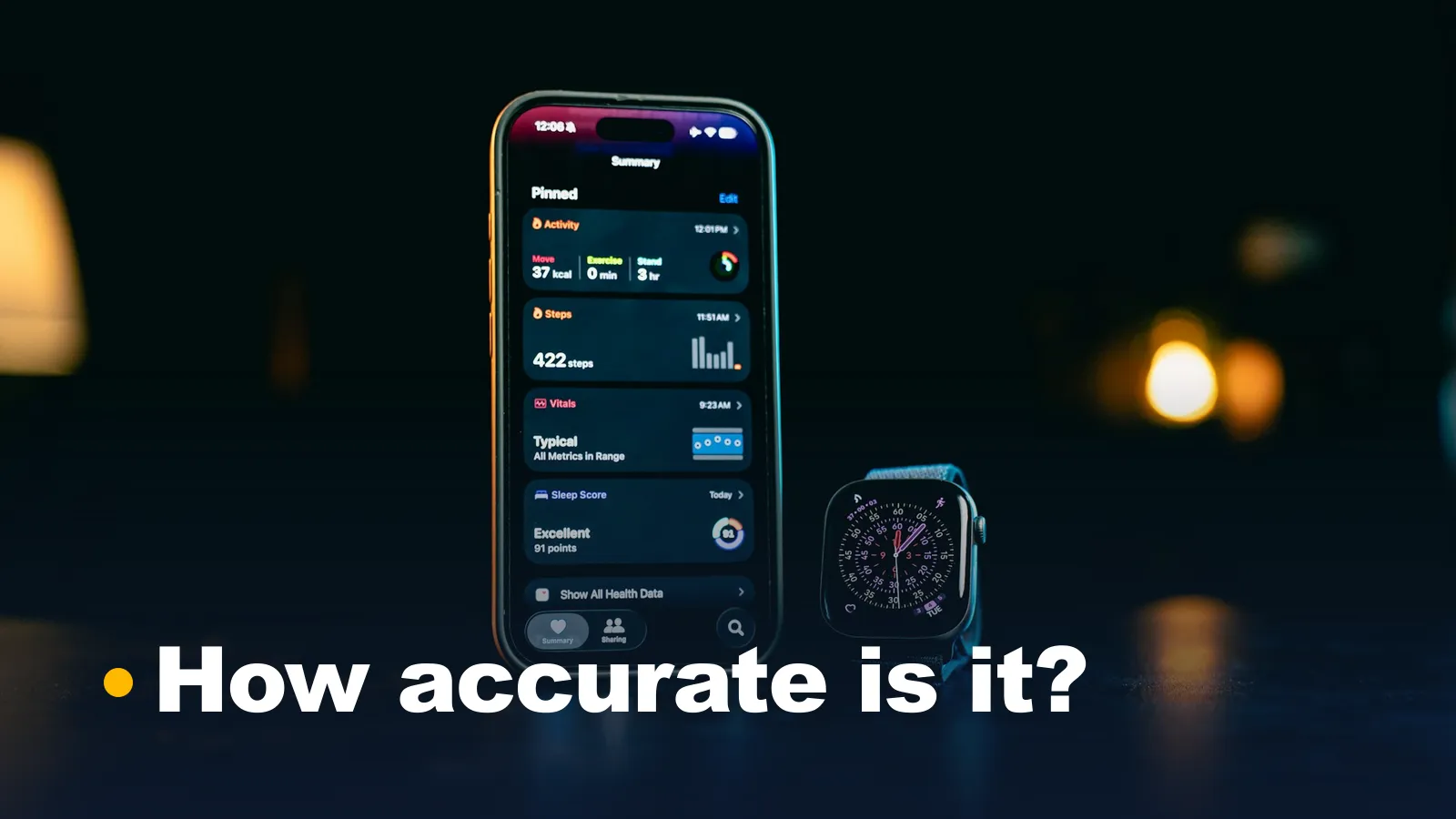
Apple Watch is very good at telling sleep from wake time but less precise on individual stages. In Apple's validation against polysomnography, the lab sleep test, the watchOS 26 algorithm detected 96.8% of sleep and 78.9% of time awake.
Polysomnography (PSG) is an overnight sleep study that records brain waves, breathing and movement, and it's the standard that wearables are measured against. 2 independent studies tested the Apple Watch Series 8 against PSG:
| Study | People | Total sleep | Deep sleep | Light sleep |
|---|---|---|---|---|
| Schyvens et al., SLEEP Advances 2025 | 62 adults (20 wore Apple Watch) | Overestimated by 19.6 min | Underestimated by 25.2 min | Overestimated by 58.75 min |
| Robbins et al., Sensors 2024 | 35 healthy adults | Sleep vs wake detection 95% or higher | Underestimated by 43 min | Overestimated by 45 min |
In the 2025 study, Apple Watch had the highest agreement of the 6 devices tested. Both studies show the same pattern: the watch reliably catches sleep but tends to score some deep sleep as light sleep. Our Oura Ring vs Apple Watch guide compares it with a ring built for sleep.
How does the Apple Watch Sleep Score work?
Sleep Score rates each night from 0 to 100 using 3 parts: duration (50 points), bedtime consistency (30 points) and interruptions (20 points). Bedtime consistency compares when you fell asleep over the last 13 nights.
Since watchOS 26.2, Apple uses 5 bands:
| Score | Band |
|---|---|
| 0 to 40 | Very Low |
| 41 to 60 | Low |
| 61 to 80 | OK |
| 81 to 95 | High |
| 96 to 100 | Very High |
You'll find the score in the Sleep app on the watch; tap Info for the breakdown.
How do you make sure your watch tracks the whole night?
Charge your Apple Watch to at least 30% before bed, because sleep isn't tracked if the battery runs out. Apple's Charging Reminders, under My Watch > Sleep in the Watch app on iPhone, remind you before bedtime.
If you'd rather not charge a watch every day, our guide to smart rings explains rings that last several days between charges, and our best smart rings guide compares 5 of them.
Common questions
Is a sleep score of 62 good on Apple Watch?
A score of 62 is OK. Apple's bands are Very Low (0 to 40), Low (41 to 60), OK (61 to 80), High (81 to 95) and Very High (96 and above), so 62 sits at the bottom of the OK band.
How do I tell my Apple Watch to track sleep?
Open the Health app on your iPhone, tap Get Started under Set Up Sleep, and follow the prompts to set a sleep goal, schedule and Sleep Focus, with Track Sleep with Apple Watch switched on. Then wear the watch to bed.
Does Apple Watch track naps?
Yes, on watchOS 11 and later. Sleep sessions of 1 to 3 hours record sleep and wake only, and sessions over 3 hours get full sleep stages.
Can Apple Watch detect sleep apnea?
It can flag signs of it. Sleep apnea notifications, cleared by the FDA, look for breathing disturbances over 30 days on Series 9 or later, Ultra 2 or later and SE 3, but they aren't a diagnosis.
Writes guides and reviews for ProductHunter.