Key takeaways
- A power inverter is a device that changes direct current (DC) from a battery or solar panel into alternating current (AC) for household devices.
- Pure sine wave inverters match grid power and suit laptops, microwaves, medical devices and LED TVs; modified sine wave inverters suit simple tools and lights.
- Inverters sit inside portable power stations, inverter generators, home batteries and solar systems, and are sold on their own for cars, RVs and boats.
- An inverter uses some extra power: it loses about 10 to 15 percent of the battery's energy as heat.
A power inverter is a device that changes direct current (DC) from a battery or solar panel into alternating current (AC), the kind of power that comes out of a wall outlet. This guide covers how an inverter works, the 2 output types, where you find inverters, how to choose a size, and how much power an inverter uses.
What does a power inverter do?
A power inverter lets a battery run devices that plug into a wall-style outlet. Batteries, solar panels and car electrical systems supply DC power, while household devices are built for AC power, and the inverter bridges the gap.
AC (alternating current) is electricity that reverses direction many times a second. DC (direct current) flows in one direction only. Our guide comparing an inverter vs a converter explains the 4 devices that change power from one form to another.
How does a power inverter work?
A power inverter works in 3 steps: it takes in DC power from a battery, switches it on and off very fast to create an alternating flow, and raises and shapes that flow into AC at household voltage.
- DC in. Power comes from a 12 V, 24 V or 48 V battery, or a solar panel.
- Switching. Electronic switches reverse the current many times a second.
- Shaping. The output is shaped into a wave at 120 V for US devices.
The quality of step 3 decides whether an inverter is pure sine wave or modified sine wave.
What is the difference between pure and modified sine wave?
A pure sine wave inverter produces a smooth wave that closely matches grid power, while a modified sine wave inverter produces a stepped, blocky wave. Xantrex, an inverter maker, says modified sine wave is cheaper but can make sensitive devices buzz, overheat or run less efficiently.
| Pure sine wave | Modified sine wave | |
|---|---|---|
| Output | Smooth, like grid power | Stepped, blocky wave |
| Runs | Everything, including sensitive electronics | Simple loads |
| Good for | Laptops, microwaves, medical devices, LED TVs, newer fridges | Simple power tools, basic lights, older appliances |
| Cost | Higher | Lower |
Where do you find power inverters?
Inverters come in 3 main forms: standalone inverters that connect to a battery, inverters built into portable power stations and generators, and solar inverters in home systems.
- Standalone inverters. They plug into a car's 12 V socket or wire to a deep-cycle battery in an RV, van or boat.
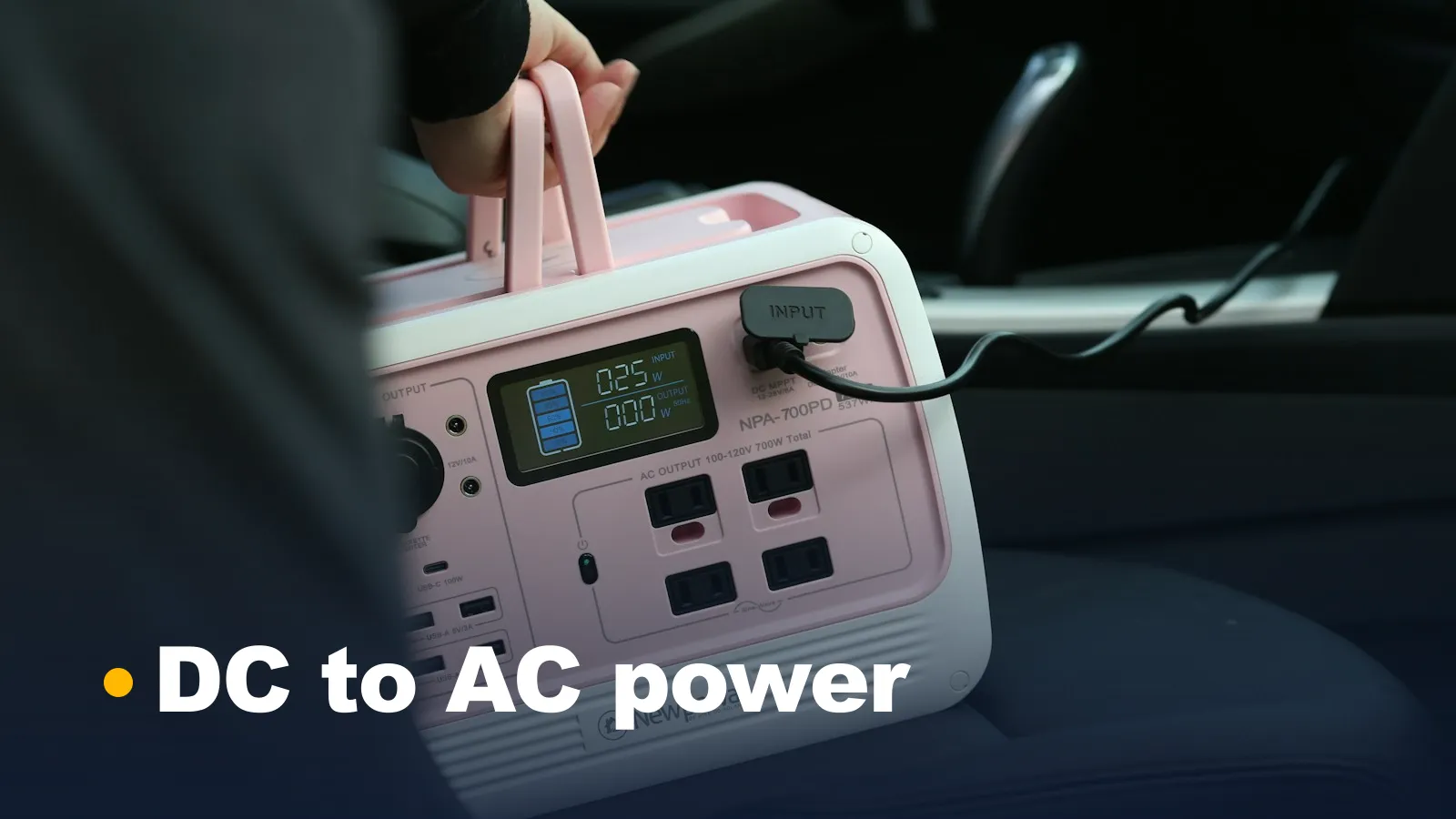
- Built-in inverters. Every portable power station has one behind its AC outlets, and an inverter generator uses one to clean up engine power.
- Solar inverters. Home solar systems use a string inverter, microinverters or power optimizers to turn panel power into household AC.
Our best portable power stations guide compares 5 stations with built-in pure sine wave inverters.
What size power inverter do you need?
Choose an inverter whose continuous rating in watts is higher than the total running watts of everything you will use at once, and whose surge rating covers any motor's start-up. Motors can pull 2 to 3 times their running watts when they start.
- List your devices and their running watts.
- Add them up for everything that runs at the same time.
- Check motors, such as fridges and pumps, for start-up surge.
- Pick an inverter rated above both numbers.
Our guide comparing a power inverter vs a generator works through sizing and battery runtime with a calculator.
Does a power inverter use a lot of power?
An inverter uses about 10 to 15 percent of the battery's energy as heat while it converts DC to AC. A 300 W device running through an inverter draws roughly 333 to 353 W from the battery.
That loss is why a battery's runtime through an inverter is its watt-hours times 0.85, divided by the load. A 12 V 100 Ah battery holds 1,200 Wh, so it runs a 300 W load for about 3 hours 24 minutes.
Common questions
Does an inverter use more power?
Yes, a little. An inverter loses about 10 to 15 percent of the battery's energy as heat while it converts DC to AC, so a device draws slightly more from the battery than its own rating.
What size inverter do I need?
Add up the running watts of everything you will power at once and choose an inverter whose continuous rating is above that total. If any device has a motor, check that the surge rating covers its start-up, which can be 2 to 3 times its running watts.
What is the function of an inverter in appliances?
In a power station, solar system or inverter generator, the inverter turns stored or generated DC power into the AC power that plugs and appliances use.
Is a modified sine wave inverter bad?
Not for simple loads. It runs basic lights, simple power tools and older appliances, but it can make sensitive devices buzz, overheat or run less efficiently.
Writes guides and reviews for ProductHunter.