Key takeaways
- Most electric skateboards reach 25 to 31 mph: the Meepo V5 is rated 28 mph and the Backfire Zealot S3 31 mph.
- A regular skateboard is much slower: a UC Davis study observed skateboarders at 6 to 14 mph, 9.7 mph on average.
- Battery size, motors, drive type, wheels, braking and certification set an e-board's cost.
- California limits electric boards to 15 mph, requires riders to be 16 or older and requires a helmet.
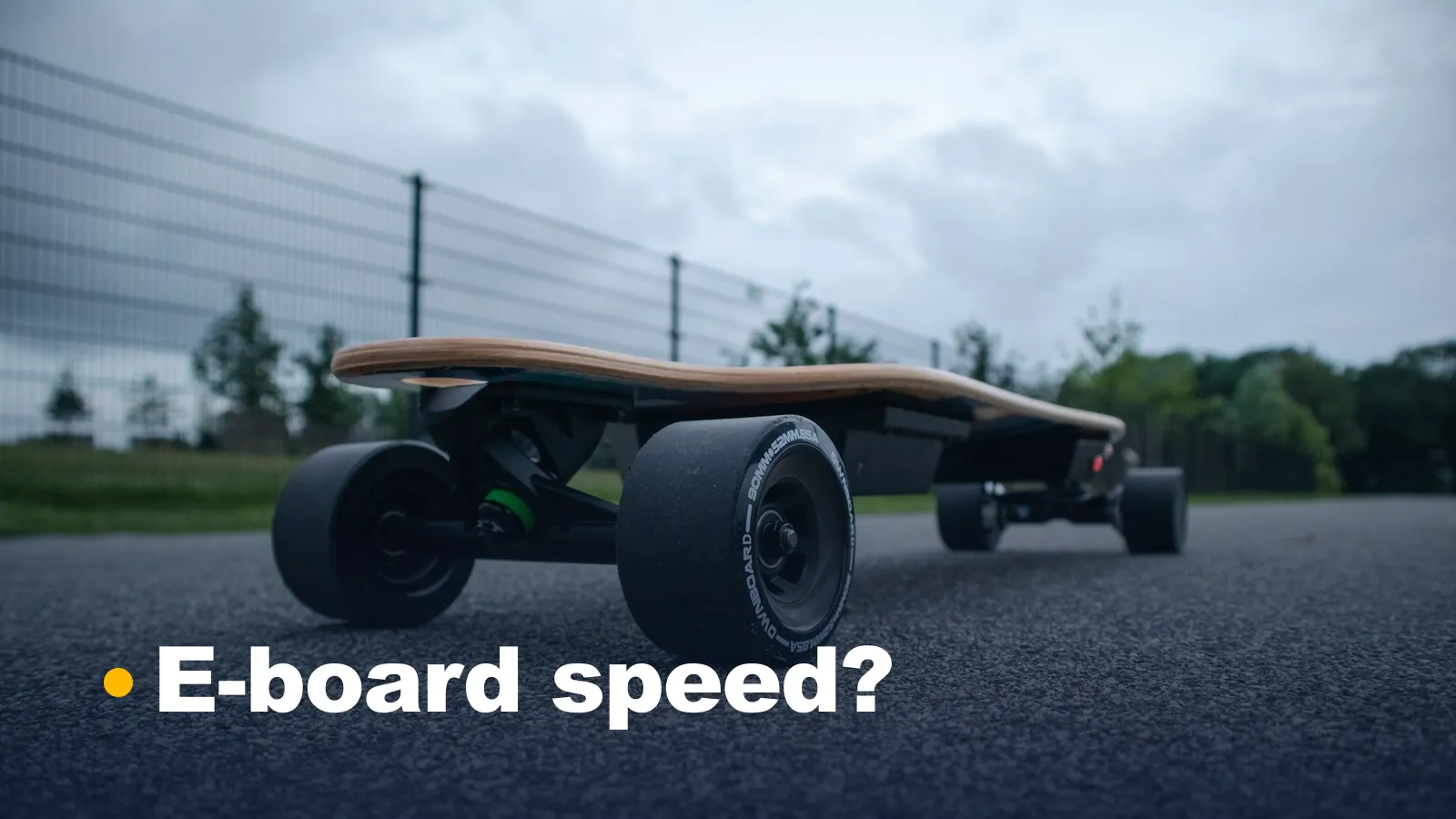
An electric skateboard is a skateboard with a battery and 1 or 2 motors, controlled by a handheld remote, that can reach 25 to 31 mph. This guide lists official speeds for 8 boards, explains what sets speed and range, covers 6 cost factors, and explains the rules and safety points.
How fast does an electric skateboard go?
Most electric skateboards reach 25 to 31 mph, about 3 times the speed of a regular board. These are makers' figures for 8 boards:
| Board | Top speed | Range claim | Battery | Weight |
|---|---|---|---|---|
| Meepo V5 | 28 mph | 11 miles | 144 Wh | 17.8 lb |
| Exway Flex (Hub) | 25 mph | 17 miles | 216 Wh | 17.0 lb |
| Evolve Stoke X | 27 mph | 28 miles | 432 Wh | 23.15 lb |
| Backfire Zealot S3 | 31 mph | 25 to 30 miles | 403 Wh | 23.5 lb |
| Tynee Mini 3 Pro | 32 mph | Up to 31 miles | 468 Wh | 20.4 lb |
| Halo Board Beast | 26 mph | 25 miles | Not stated in Wh | 23 lb |
| Backfire Ranger X6 | 26 mph | 17 to 21 miles | 648 Wh | 28 lb |
| Evolve Diablo Street | 31 mph | 50 miles | 864 Wh | 31 lb |
Ride modes cap the speed for beginners: the Tynee's 4 modes run at 9, 15, 21 and 32 mph. A regular skateboard is far slower: a UC Davis study observed riders at 6 to 14 mph, 9.7 mph on average. Our Tynee board review covers Tynee's boards.
What affects an electric skateboard's speed and range?
Battery size, wheels, drive type and riding conditions set how far and how fast you go. Meepo and Tynee say their ratings are measured in ideal conditions, and Backfire tests with a 176 lb (80 kg) rider at 18.6 mph on flat road. These are the 4 biggest factors:
- Battery size. Measured in watt-hours (Wh), a unit of stored energy. Exway's Flex goes from 16 to 17 miles with 216 Wh to 28 miles with 345 Wh.
- Wheels and terrain. Evolve rates the same 864 Wh Diablo at 50 miles on street wheels but 31 miles on 175 mm all-terrain tires.
- Rider and conditions. Meepo and Tynee list rider weight, terrain, wind, temperature, speed and brake mode.
- Voltage. Exway says its 12S battery platform is 5% more efficient than its 10S one.
Our guide to how fast an electric scooter can go compares scooter speeds.
What affects the cost of an electric skateboard?
6 factors make one board cost more than another:
- Battery size and cells. Packs run from 144 Wh on the Meepo V5 to 864 Wh on the Evolve Diablo, and higher-end boards name their cells, such as Samsung 50S in Evolve and Tynee boards.
- Motors. From dual 500 W hub motors on the Meepo V5 to dual 3,500 W motors on the Evolve Diablo.
- Drive type. Hub motors sit inside the wheels and are quiet and low-maintenance, Meepo says; belt drives need replacement belts, so Backfire packs 2 spares with the Zealot S3.
- Wheels. Street boards use 85 to 105 mm urethane wheels, while all-terrain boards use 165 to 175 mm rubber or pneumatic tires.
- Braking and remote. Evolve, Tynee and Halo boards brake through the motor and recharge the battery as they slow, called regenerative braking.
- Water resistance and certification. Ratings range from IPX5 (Meepo) to IP65 (Backfire), and the Halo Board Beast is certified to UL 2272, a safety standard for the electrical system, battery and charger.
Warranty length varies too: Exway gives 12 months on its standard boards, while Meepo and Tynee give 6 months. Our Halo Board review covers the Halo Beast in detail.
What are the rules for electric skateboards?
Rules vary widely by state, and many states have no specific law. California has the clearest rules for electrically motorized boards:
| California rule | Requirement |
|---|---|
| Age | 16 or older (VC 21291) |
| Helmet | A fastened bicycle helmet, everywhere (VC 21292) |
| Speed | 15 mph maximum on roads, bikeways, paths and sidewalks (VC 21294) |
| Roads | Speed limit 35 mph or less, unless in a Class II or IV bike lane |
| Night | White headlamp and red rear reflector (CHP) |
Virginia treats motorized skateboards as not being motor vehicles, with a 20 mph maximum and adult supervision for riders under 14. New York has no legal category for electric skateboards yet, so check your state and city before riding.
Are electric skateboards safe?
Ride with a helmet and at a speed you can control: there is no crash protection beyond what you wear. The US Consumer Product Safety Commission (CPSC) doesn't publish a separate injury count for electric skateboards, so there's no official figure.
CPSC's general advice for e-mobility devices covers 4 points:
- Wear a bicycle helmet on every ride.
- Charge only while you're awake, never overnight.
- Use the maker's own charger and batteries.
- Choose certified products, such as those certified to UL 2272.
Watch for speed wobble, a side-to-side shake at speed. Retrospec links it to higher speed, soft bushings and a loose back truck, and advises riding no faster than you can control. Our guide to e-bikes vs electric scooters compares other ways to ride short trips.
Common questions
Is an electric skateboard easier to ride than a regular one?
For starting out, often yes. Evolve says e-boards can be easier for beginners because there's no kick-pushing and the softer, longboard-style wheels are less tiring, and beginner modes cap speed, such as 9 mph on the Tynee Mini 3 Pro.
Do you need a license to ride an electric skateboard?
California's electric board rules list no license requirement, but riders must be 16 or older and wear a helmet. Virginia says motorized skateboards aren't motor vehicles. Rules vary, so check your state and city.
How fast is an average skateboard?
About 10 mph. A UC Davis study observed skateboarders at 6 to 14 mph, 9.7 mph on average, slightly slower than cyclists.
Can you ride an electric skateboard in the rain?
Only if its maker allows it. Meepo rates the V5 IPX5 but says it isn't designed for heavy rain or standing water, while Backfire rates its boards IP65.
Writes guides and reviews for ProductHunter.