Key takeaways
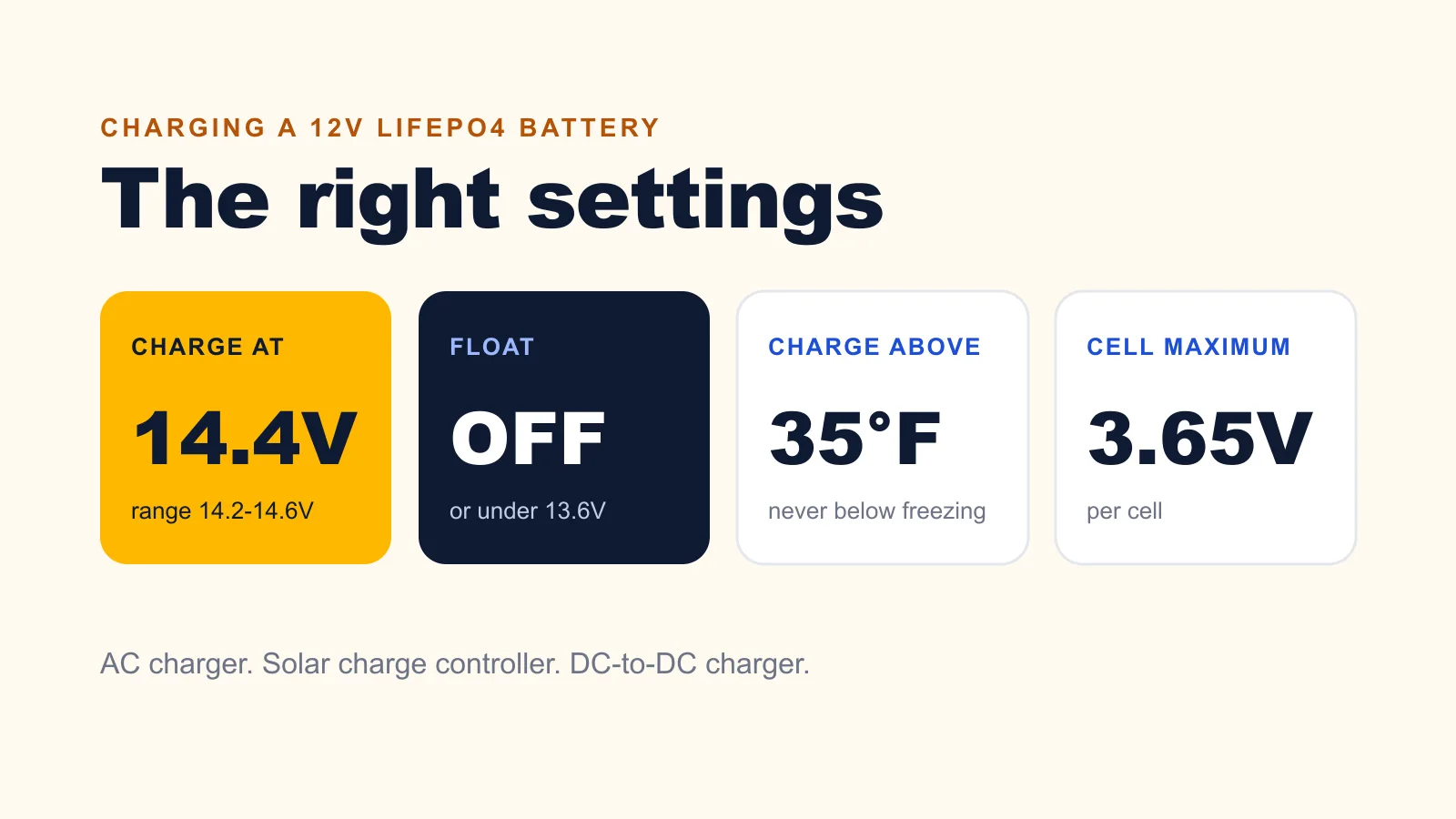
- Charge a 12 V LiFePO4 battery at 14.2 to 14.6 V; Battle Born recommends 14.4 V.
- A LiFePO4 battery needs no float charge; keep any float under 13.6 V.
- Never charge a LiFePO4 battery below freezing unless it has a built-in heater.
- Solar charge controllers need a LiFePO4 setting or custom voltages that match the battery.
Charging a LiFePO4 battery means filling it with a constant current, then holding a set voltage until the current tapers off, with no float stage afterward. This guide covers the 5 steps to charge a LiFePO4 battery safely, the exact voltage settings, charge current, temperature limits, and how to charge from solar panels and a car alternator.
How do you charge a LiFePO4 battery?
Charge a LiFePO4 battery with a charger set to a LiFePO4 profile: 14.2 to 14.6 V for a 12 V battery, no float or a float under 13.6 V, and only above freezing. Battle Born, a US LiFePO4 maker, recommends 14.4 V.
Charging takes 5 steps:
- Check that the battery is above 35°F (about 2°C), the minimum Battle Born gives for charging.
- Set the charger to its LiFePO4 mode, or enter 14.4 V for bulk and absorption on a 12 V battery.
- Turn float charging off, or set it under 13.6 V.
- Connect the charger to the battery: positive to positive, negative to negative.
- Let the charger finish. Charging ends when the current drops to a small fraction of the battery's capacity at the set voltage.
What voltage should you charge a LiFePO4 battery at?
Charge at 3.55 to 3.65 V per cell, which is 14.2 to 14.6 V for a 12 V battery. The absolute ceiling is 3.65 V per cell; anything higher stresses the cells without adding meaningful capacity.
| Setting | 12 V | 24 V | 48 V |
|---|---|---|---|
| Bulk and absorption | 14.2 to 14.6 V | 28.4 to 29.2 V | 56.8 to 58.4 V |
| Recommended (Battle Born) | 14.4 V | 28.8 V | 57.6 V |
| Float | Off, or under 13.6 V | Off, or under 27.2 V | Off, or under 54.4 V |
| Maximum per cell | 3.65 V | 3.65 V | 3.65 V |
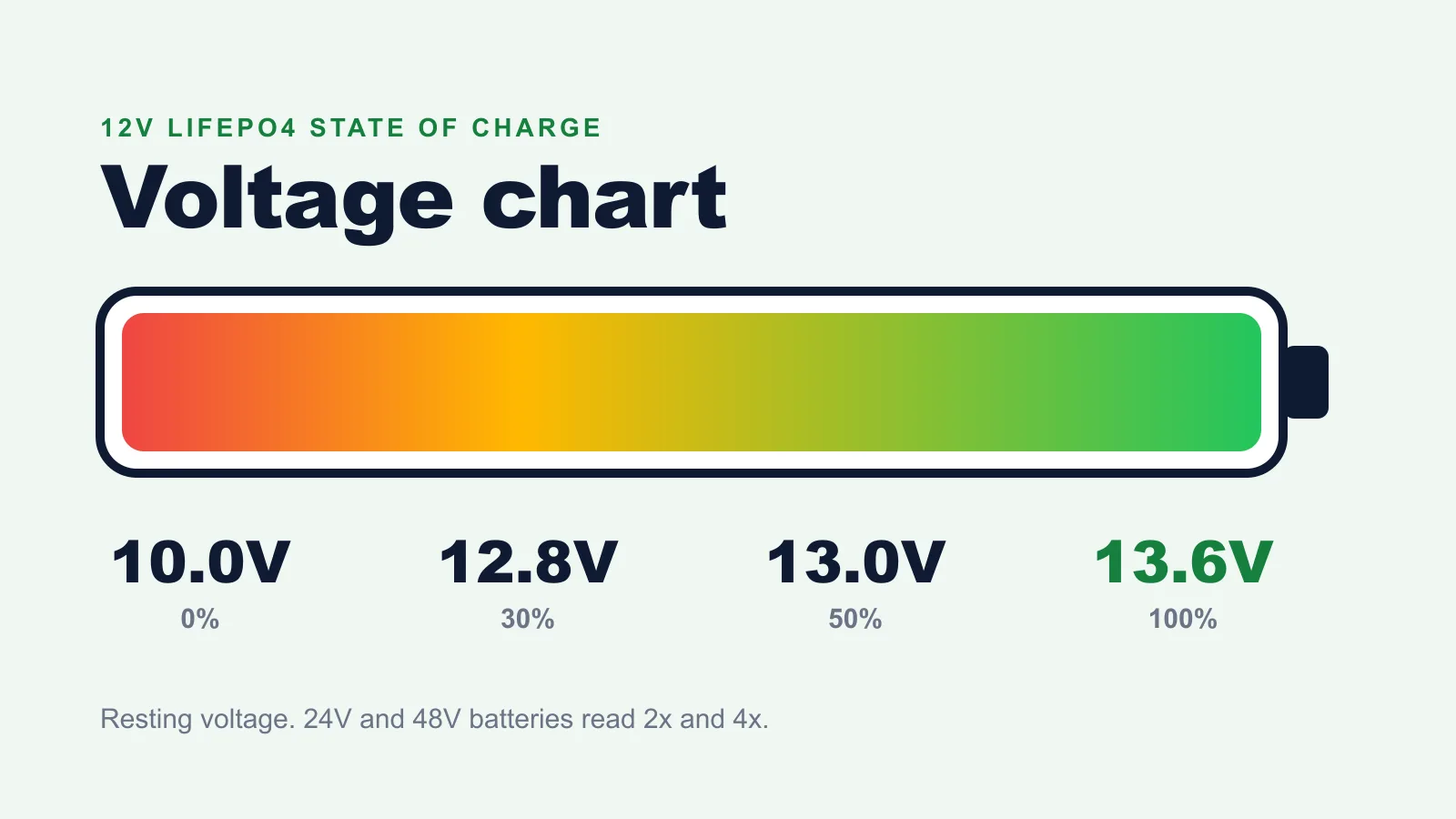
24 V and 48 V batteries use 2 and 4 times the 12 V values, because they have 8 and 16 cells in series instead of 4. Our LiFePO4 voltage chart shows what each resting voltage means for state of charge.
Why does a LiFePO4 battery not need a float charge?
A LiFePO4 battery needs no float charge because it holds its charge when the charger is off, losing only about 1 to 3 percent per month. A lead-acid battery loses charge quickly off the charger, so lead-acid chargers hold a float voltage of 13.2 to 13.8 V.
Holding a LiFePO4 battery at a high voltage around the clock adds no benefit. If a charger cannot turn float off, keep the float under 13.6 V.
How fast can you charge a LiFePO4 battery?
Charge a LiFePO4 battery no faster than the maximum current on its datasheet. Many datasheets list 0.5C, which is half the capacity in amps: 50 A for a 100 Ah battery, which fills it in about 2 hours.
The Rolls Surrette S12-150LFP datasheet, for example, allows 0.5C between 10°C and 35°C (50°F and 95°F), lowers the rate in colder and hotter conditions, and ends charging when the current falls to 0.05C. Every battery's own limits come first.
Can you charge a LiFePO4 battery below freezing?
No. Charging a LiFePO4 battery below freezing damages the cells permanently. Battle Born says its batteries need to stay above 35°F to charge, and most battery management systems block charging below 32°F (0°C).
LiFePO4 batteries can still discharge in the cold. For winter charging, choose a battery with a built-in heater, which warms the cells before the charger starts. Our guide to LiFePO4 battery life covers the other habits that protect the cells.
How do you charge a LiFePO4 battery with solar panels?
Charge a LiFePO4 battery from solar panels through a charge controller set to a LiFePO4 profile, or to custom values of 14.4 V absorption and no float. The controller sits between the panels and the battery and limits the voltage and current.
Solar charging takes 3 steps:
- Connect the charge controller to the battery first, so it detects the battery voltage.
- Select the LiFePO4 preset, or enter the voltages from the table above.
- Connect the solar panels to the controller.
A portable power station has the controller built in, so its solar panels plug straight into its solar input. All 5 picks in our best portable power stations buying guide have a solar input, rated from 1,000 W to 2,400 W. Our ALLWEI power station review looks at another LiFePO4 brand with fast charging and solar compatibility.
How do you charge a LiFePO4 battery from a car alternator?
Charge a LiFePO4 house battery from a vehicle's alternator through a DC-to-DC charger. A DC-to-DC charger is a device that takes the vehicle's charging voltage and converts it to a LiFePO4 charging profile at a set current.
Vehicle alternators are regulated for the vehicle's starter battery, not for a LiFePO4 profile, so the charger handles the voltage and current the LiFePO4 battery needs.
Common questions
Is it OK to charge a LiFePO4 battery to 100 percent?
Yes. LiFePO4 batteries handle full charges in normal use. For storage longer than a few months, leave the battery at about 50 percent instead.
Can I use a lead-acid charger on a LiFePO4 battery?
Only if its voltages fit the battery. Battle Born says many chargers work if their bulk and absorption voltage is 14.2 to 14.6 V and the float stays under 13.6 V. Avoid chargers with equalization or desulfation modes, which push the voltage higher.
Is slow charging better for LiFePO4 batteries?
Charging within the maker's current limit is what matters. A rate of 0.5C or lower, such as 50 A for a 100 Ah battery, is a common limit on datasheets.
Writes guides and reviews for ProductHunter.