Key takeaways
- LiFePO4 is a type of lithium-ion battery; the usual comparison is LiFePO4 against NMC lithium-ion.
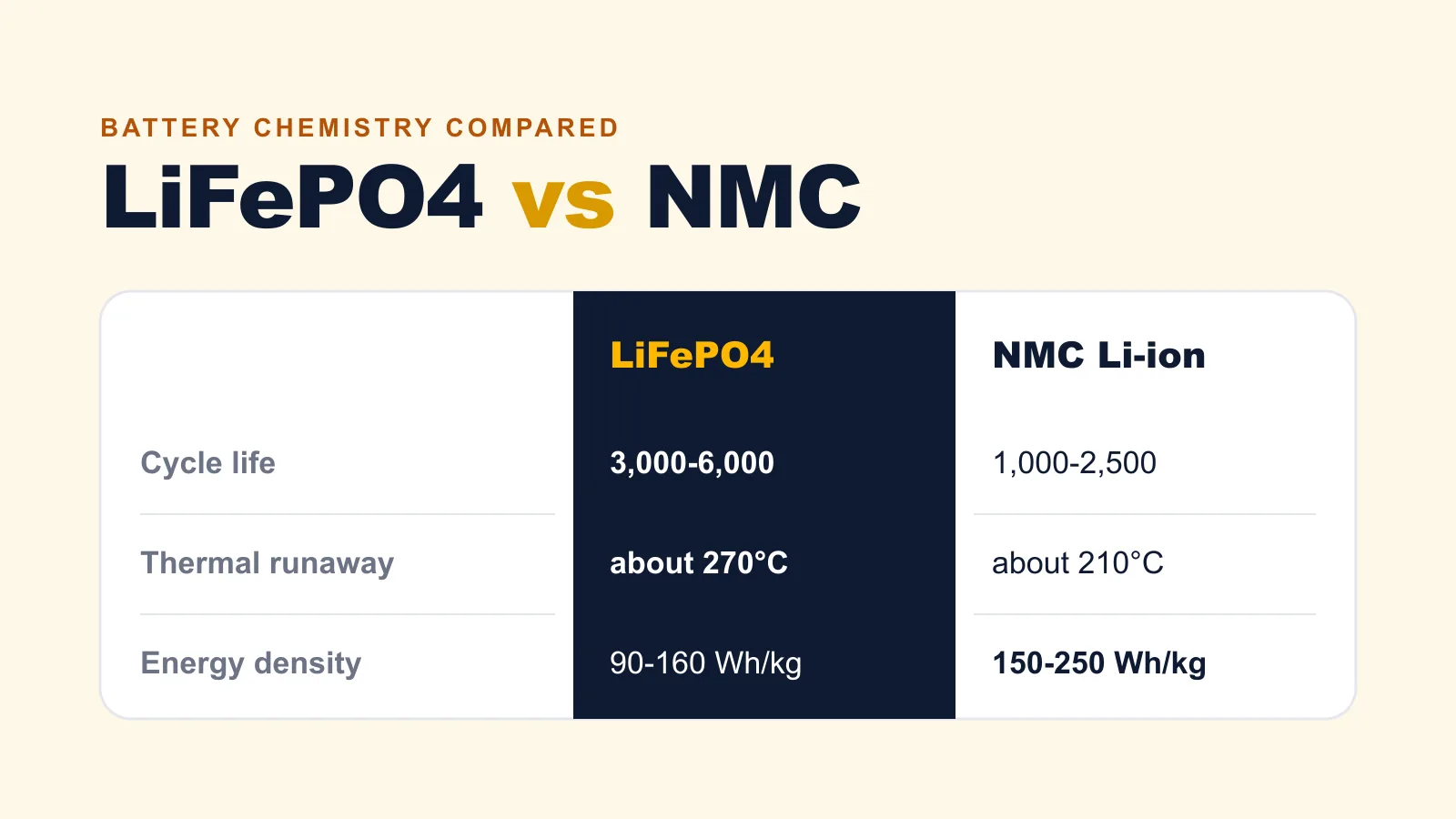
- LiFePO4 lasts about 3,000 to 6,000 cycles, against 1,000 to 2,500 for NMC.
- NMC stores about 150 to 250 Wh per kilogram, against 90 to 160 Wh/kg for LiFePO4.
- LiFePO4 reaches thermal runaway near 270°C, about 60°C higher than NMC.
LiFePO4 (lithium iron phosphate) is a lithium-ion battery chemistry that trades some energy density for a longer cycle life and higher thermal stability. When people compare "LiFePO4 vs lithium-ion", they mean LiFePO4 against NMC, the nickel manganese cobalt chemistry in most phones, laptops and many electric cars. This guide covers which battery is better for which job, a side-by-side table, safety, lifespan, weight, and why the two need different chargers.
Which is better, LiFePO4 or lithium-ion?
LiFePO4 is better for power stations, solar storage, RVs and boats, where long life and safety matter more than weight. NMC lithium-ion is better for phones, laptops, drones and long-range electric cars, where every gram and every cubic centimeter counts.
The choice comes down to one trade-off: LiFePO4 lasts 2 to 3 times as many cycles and resists overheating, while NMC packs more energy into the same weight.
How do LiFePO4 and NMC compare?
LiFePO4 wins on cycle life, safety and materials; NMC wins on energy density. The table compares the 2 chemistries using figures from battery maker comparisons, which test cycle life at 100 percent depth of discharge to 80 percent remaining capacity.
| LiFePO4 (LFP) | NMC lithium-ion | |
|---|---|---|
| Nominal cell voltage | 3.2 V | 3.6 to 3.7 V |
| Maximum charge voltage per cell | 3.65 V | 4.2 V |
| Energy density | 90 to 160 Wh/kg | 150 to 250 Wh/kg |
| Cycle life | 3,000 to 6,000 | 1,000 to 2,500 |
| Thermal runaway temperature | About 270°C (518°F) | About 210°C (410°F) |
| Cobalt | None | Yes |
| Typical uses | Power stations, solar, RV, marine | Phones, laptops, EVs, drones |
Which battery is safer?
LiFePO4 is safer, because its cells reach thermal runaway at about 270°C, roughly 60°C higher than NMC cells. Thermal runaway is a chain reaction in which a cell heats itself until it vents or catches fire.
The iron phosphate cathode holds its oxygen more tightly than nickel-based cathodes, so a damaged or overheated LiFePO4 cell releases less heat.
Which battery lasts longer?
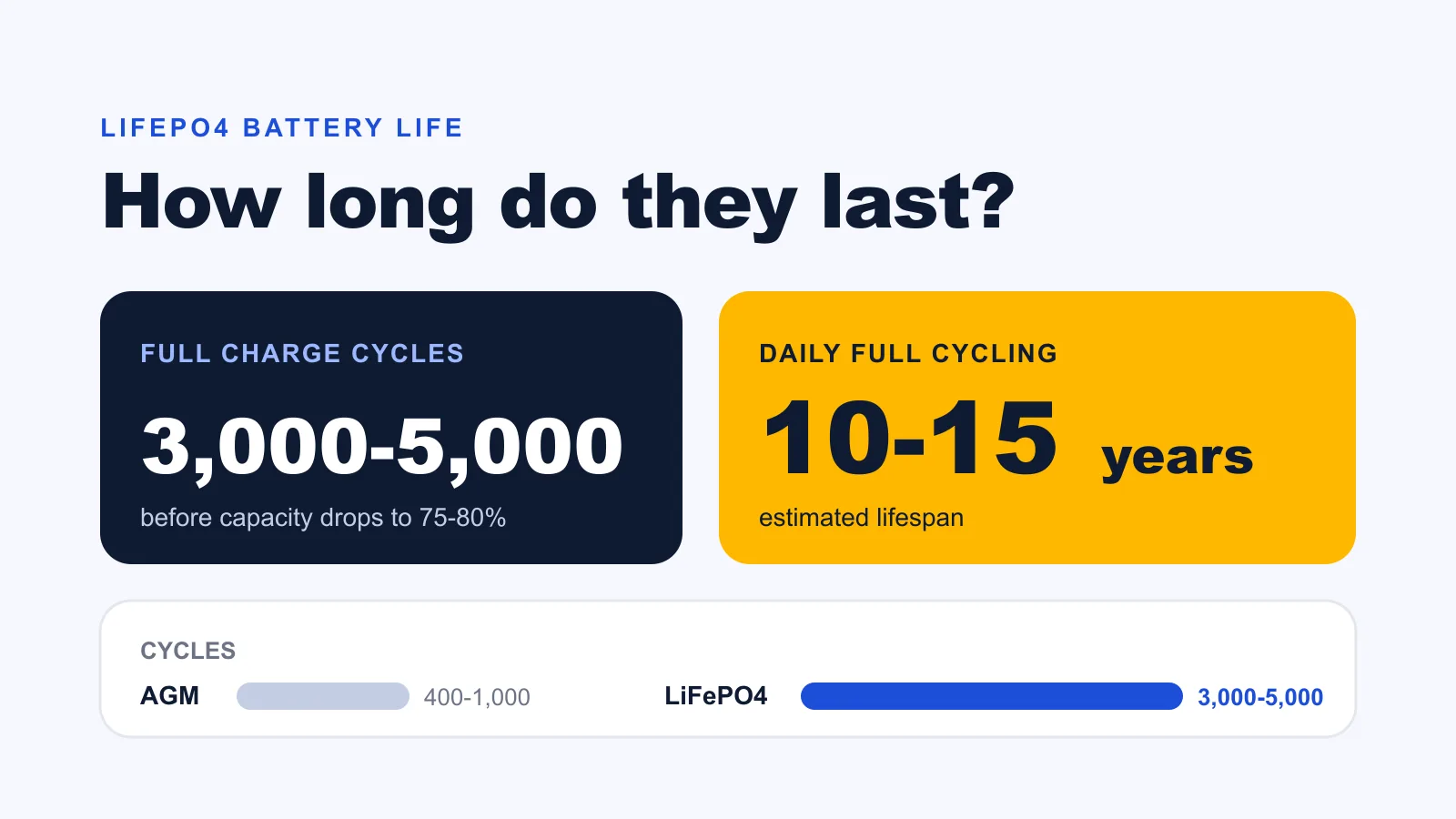
LiFePO4 lasts longer: about 3,000 to 6,000 full cycles against 1,000 to 2,500 for NMC. Heat narrows the gap less for LiFePO4, too. Battery maker comparisons report that cycle life at 45°C falls by 20 to 30 percent for LiFePO4 and by 40 to 50 percent for NMC.
Our guide to LiFePO4 battery life explains what a cycle is and which habits shorten a battery's life.
Which battery is lighter and smaller?
NMC is lighter and smaller for the same capacity. At 150 to 250 Wh per kilogram against 90 to 160 Wh/kg for LiFePO4, an NMC pack weighs about 40 percent less for the same watt-hours, comparing the middle of each range.
This is why a LiFePO4 battery weighs more than an NMC battery of the same capacity, and why phones use NMC-type cells.
Can you charge LiFePO4 with a lithium-ion charger?
No. A standard lithium-ion charger charges each cell to 4.2 V, while a LiFePO4 cell must stay at or below 3.65 V. For a 4-cell 12 V battery, that is 16.8 V against a 14.6 V limit, enough to overcharge and damage LiFePO4 cells.
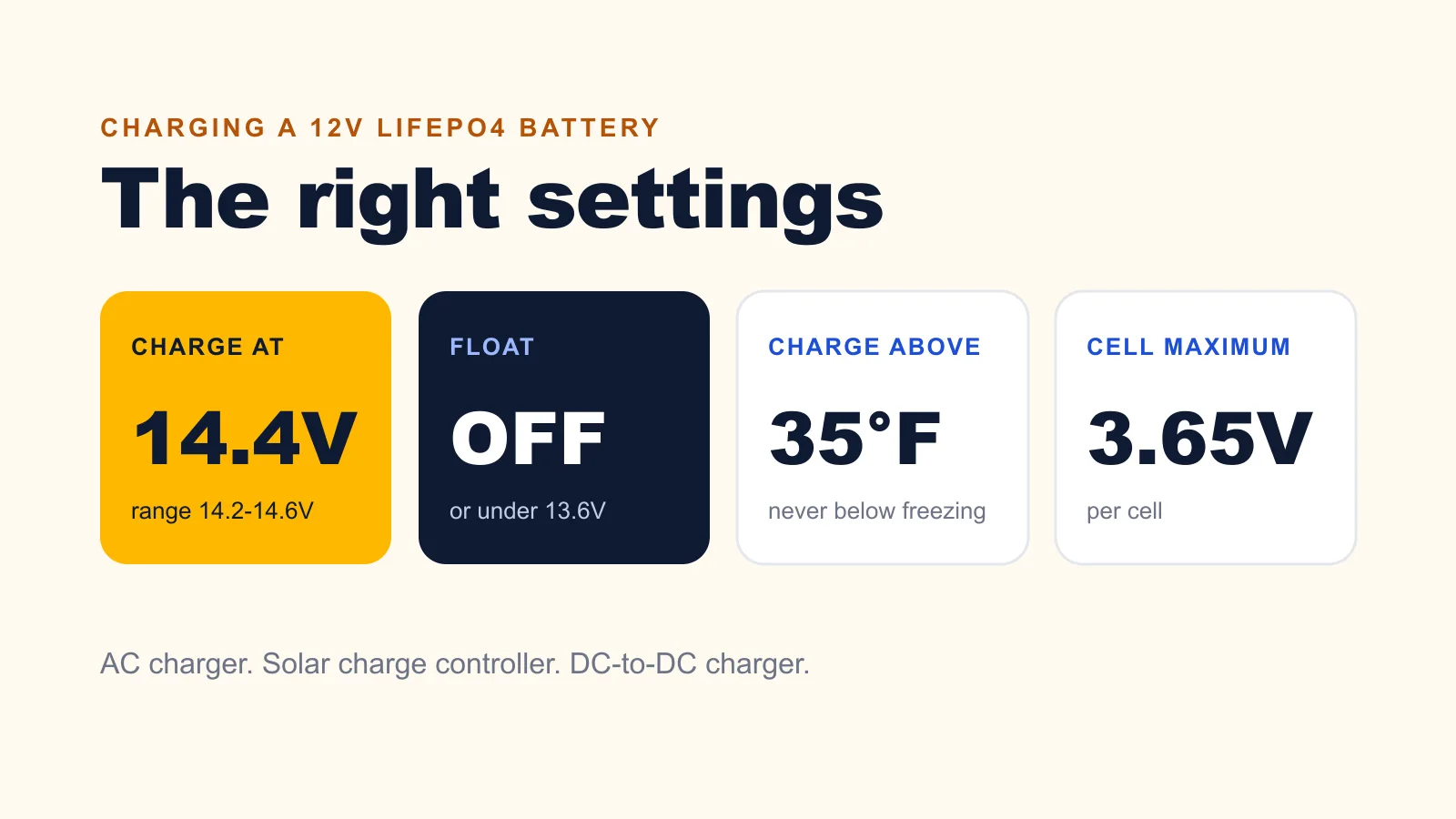
Use a charger with a LiFePO4 profile, set to 14.2 to 14.6 V for a 12 V battery. Our guide on how to charge a LiFePO4 battery lists the exact settings for AC chargers, solar and alternators.
Which should you choose?
Choose by how you use the battery. 3 common cases:
- Backup power, solar or camping: LiFePO4, for its cycle life and safety. All 5 picks in our best portable power stations buying guide use LiFePO4 cells.
- Carrying power in a bag: NMC, for its lower weight, as in power banks and laptops.
- RV or boat house battery: LiFePO4, which also replaces heavier lead-acid batteries. Our FOSSiBOT portable power stations review covers one LiFePO4 brand in detail.
Common questions
Is LiFePO4 the same as lithium iron phosphate?
Yes. LiFePO4 is the chemical formula of lithium iron phosphate, and the chemistry is also called LFP.
Why are phones and laptops not LiFePO4?
Because weight and size matter more than cycle life in a phone or laptop. NMC and similar chemistries store more energy in the same space.
Do LiFePO4 batteries contain cobalt?
No. LiFePO4 uses iron and phosphate in its cathode, while NMC uses nickel, manganese and cobalt.
Writes guides and reviews for ProductHunter.