Key takeaways
- Class 1 and Class 2 e-bikes stop helping at 20 mph, and Class 3 e-bikes stop helping at 28 mph.
- You can ride faster than the limit on your own pedal power or downhill, but the motor gives no help above it.
- Rider and cargo weight, hills, wind, assist level and battery charge all change your real speed.
- A bike that assists above 28 mph or has a motor of 750 W or more falls outside the 3 classes and is often treated as a moped.
An electric bike's top speed is the speed at which its motor stops helping, and in the US that is 20 mph for Class 1 and Class 2 e-bikes and 28 mph for Class 3. This guide covers the speed of each class, the 5 things that change how fast you actually ride, what happens with e-bikes that go faster than 28 mph, and the downsides of a faster e-bike.
How fast can an electric bike go?
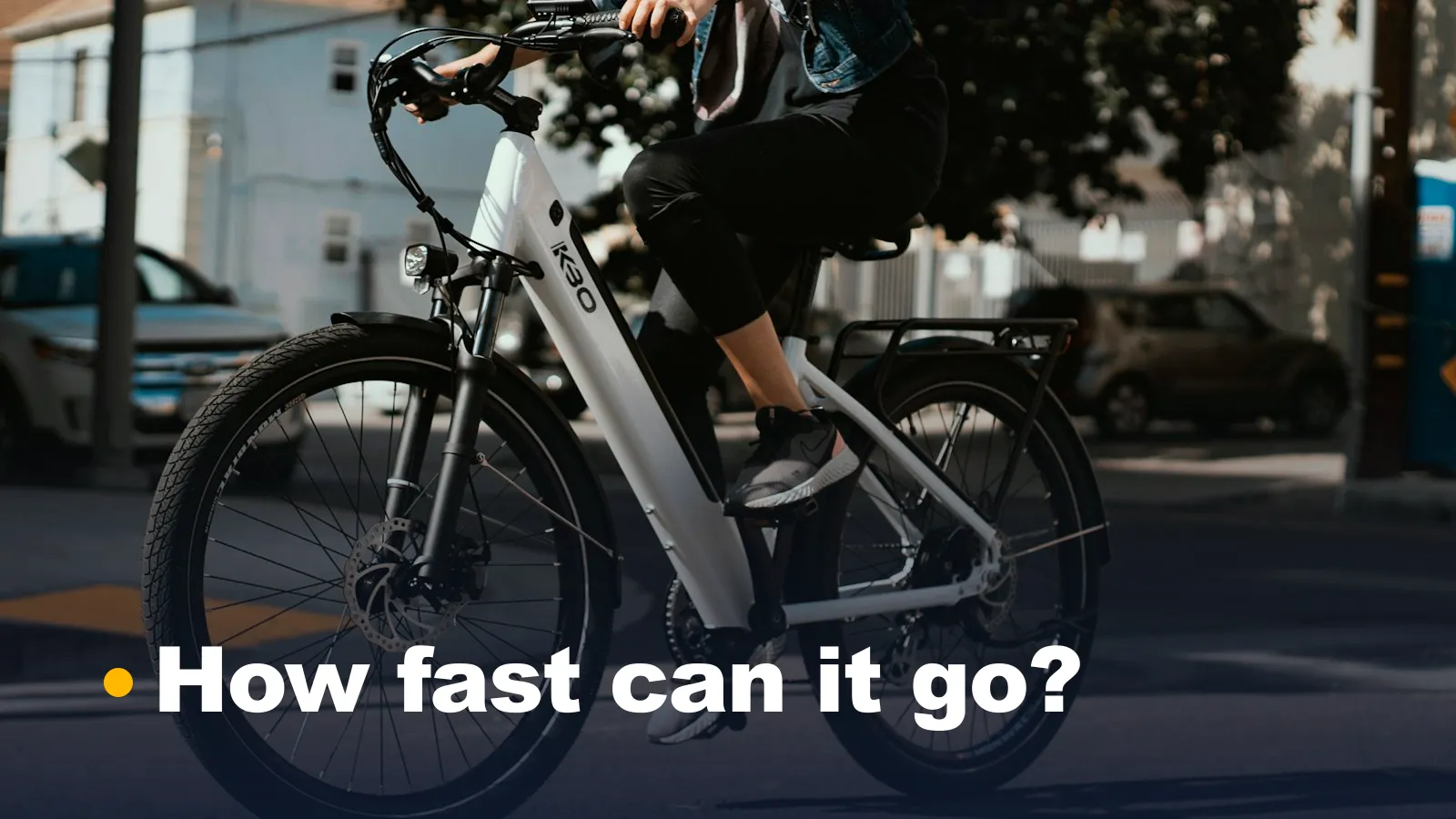
An electric bike goes up to 20 mph on motor assistance if it is Class 1 or Class 2, and up to 28 mph if it is Class 3. Above those speeds the motor stops helping, though you can still pedal faster.
US federal law sets these limits in its definition of an electric bicycle, which also requires working pedals and a motor of less than 750 watts. Our guide to e-bike classes explains each class and where it may ride.
| Class | How the motor helps | Motor stops helping at |
|---|---|---|
| Class 1 | Only while you pedal | 20 mph |
| Class 2 | Throttle, often pedal assist too | 20 mph |
| Class 3 | Only while you pedal | 28 mph |
What affects how fast an e-bike goes?
5 things decide how fast an e-bike actually goes on a ride: its class limit, the assist level you choose, the weight it carries, hills and wind, and how much charge is left in the battery.
- Class limit. The motor cuts out at 20 or 28 mph, whatever its power.
- Assist level. Lower assist settings add less power, so you ride slower and the battery lasts longer.
- Rider and cargo weight. A heavier load needs more power to reach the same speed.
- Hills and wind. Climbs and headwinds pull your speed below the limit. Going downhill, gravity can carry you past it, with no motor help.
- Battery and motor. A bigger battery and a stronger motor hold speed better on hills. Battery size is measured in watt-hours (Wh): the bikes in our best electric bikes guide range from 360 Wh to 960 Wh.
Can an e-bike go faster than 28 mph?
Yes, some can, but an electric bike that assists above 28 mph, or has a motor of 750 W or more, is no longer a Class 1, 2 or 3 e-bike under US federal law. Many states treat it as a moped or motorcycle.
These faster models are sold online next to regular e-bikes. The Jasion YR20 in our electric bikes guide reaches 32 mph with a 1,000 W motor, and our Movcan electric bikes review covers models with top speeds of 28 to 37.5 mph. Check the class label and your state's rules before you buy one for public roads and bike lanes.
How fast is too fast for an e-bike?
Too fast, in legal terms, means faster than your e-bike's class allows on the paths where you ride. Some states and cities keep Class 3 e-bikes off multi-use paths, and some restrict throttles, so the right speed depends on where you are.
Riding at 28 mph on a busy shared path leaves pedestrians and other riders little time to react. On roads and bike lanes, a Class 3 e-bike helps you keep up with traffic.
What are the downsides of a faster e-bike?
A faster e-bike has 4 main downsides: more limits on where you can ride, faster battery drain at high assist, more weight from a bigger motor and battery, and, above 28 mph, possible registration and license rules.
- Fewer places to ride. Class 3 and faster bikes face more path and trail restrictions.
- Shorter range at high speed. High assist levels draw more power from the battery.
- More weight. Bigger batteries and motors add weight you notice when lifting or carrying the bike.
- Battery safety. Choose a bike with a UL 2849 certified electrical system, a US safety standard for the battery, charger and motor together.
Our Aipas electric bike review looks at another brand's speeds and range.
Common questions
Can an e-bike go 40 mph?
Some electric two-wheelers sold as e-bikes can, but at 40 mph they are outside the 3 e-bike classes. Many states treat them as mopeds or motorcycles, which can need registration and a license.
Is a Class 2 e-bike faster than a Class 1?
No. Both stop helping at 20 mph. The difference is the throttle: a Class 2 bike can move on motor power alone, while a Class 1 bike helps only while you pedal.
Do e-bikes slow down uphill?
Yes. A hill makes the motor and rider work harder, so speed drops below the assist limit unless you raise the assist level or pedal harder.
Writes guides and reviews for ProductHunter.