Key takeaways
- 6 factors set a 3D printer's cost: printing technology, build volume, speed, multi-colour printing, an enclosure and running costs.
- ISO/ASTM 52900 groups all 3D printing into 7 process categories; home printers mostly use material extrusion (FDM) or vat photopolymerization (resin).
- A 1 kg spool of 1.75 mm PLA holds about 335 m of filament.
- Metal 3D printing exists, mainly through industrial powder bed fusion machines, not desktop printers.
The cost of a 3D printer is set mostly by 6 factors: the printing technology, the build volume, the print speed, multi-colour printing, an enclosure, and the running costs of filament or resin. This guide explains each factor, the 7 types of 3D printing, what you spend after you buy the printer, and how to choose a machine for the way you print. It does not list prices, which change often, but it shows what separates an entry-level printer from a higher-end one.
What makes one 3D printer cost more than another?
6 factors make one 3D printer cost more than another: the printing technology, how big a part it can print, how fast it prints, whether it prints several colours, whether it has an enclosure, and what it costs to run.
| Factor | Entry-level printer | Higher-end printer |
|---|---|---|
| Technology | Open-frame FDM | Enclosed FDM, or resin for fine detail |
| Build volume | About 220 × 220 × 220 mm | 256 mm and up per side |
| Speed | Slower, manual tuning | Up to 600 mm/s on CoreXY machines |
| Colours | 1 filament at a time | Up to 4 colours or materials automatically |
| Enclosure | None | Fully enclosed, sometimes with a heated chamber |
| Setup | Manual bed levelling | Automatic calibration |
The printers in our best 3D printers guide show the upper end of this range. The FLASHFORGE AD5X prints up to 4 colours automatically, and the FLASHFORGE Creator 5 Pro adds a 65°C heated chamber and a 320°C nozzle for engineering filaments such as nylon and PC.
What are the 7 types of 3D printing?
The 7 types of 3D printing are the process categories in the ISO/ASTM 52900 standard: binder jetting, directed energy deposition, material extrusion, material jetting, powder bed fusion, sheet lamination and vat photopolymerization. Every 3D printing process fits one of them.
Home and hobby printers use 2 of the 7:
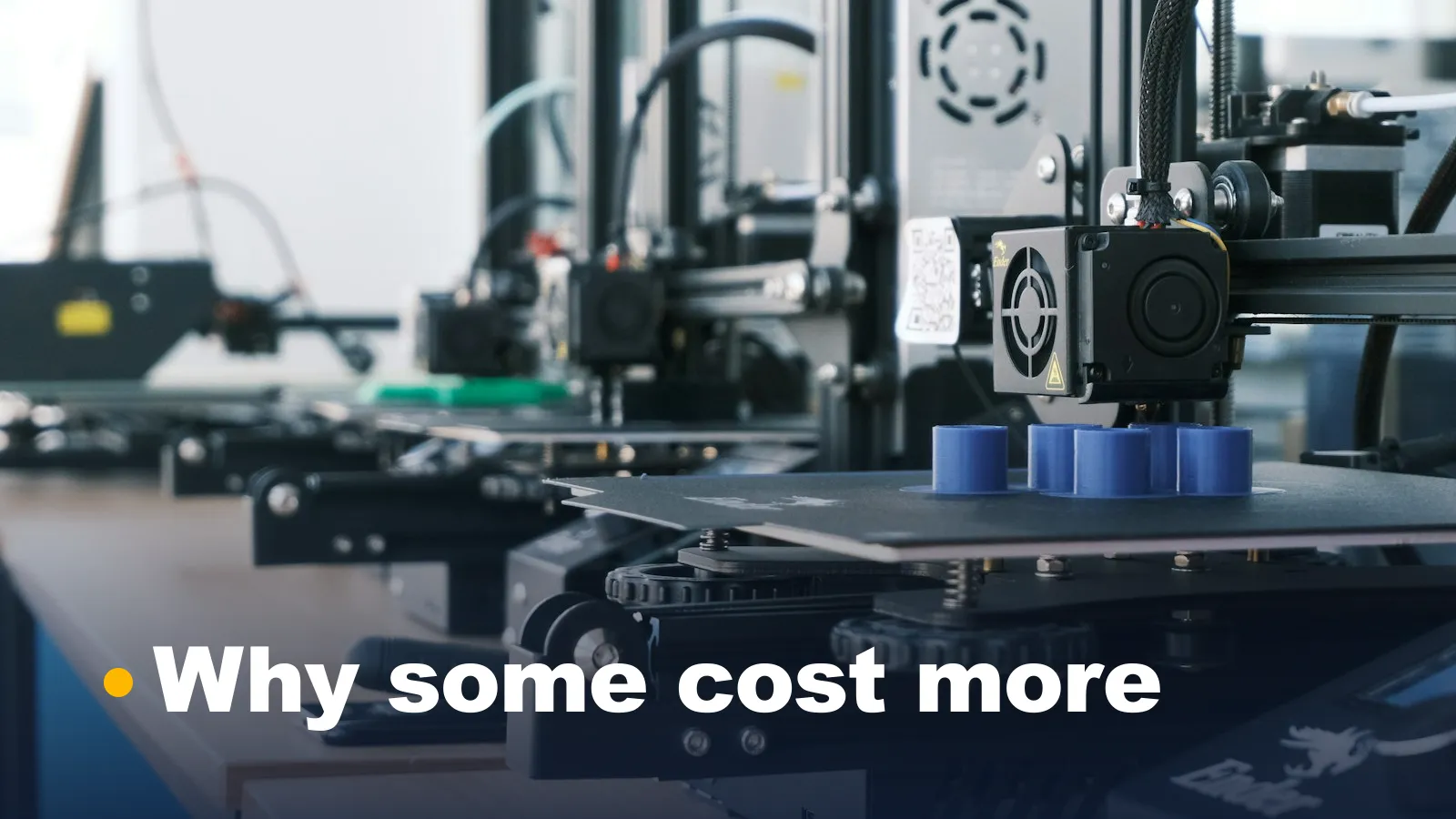
- Material extrusion (FDM). Fused deposition modelling melts plastic filament and lays it down layer by layer. Most home printers, including all 5 in our 3D printers guide, work this way.
- Vat photopolymerization (resin). A light source hardens liquid resin layer by layer, which gives finer detail but needs gloves, ventilation and washing of each print.
The other 5 categories, such as powder bed fusion for metal parts, are mainly industrial.
What does a 3D printer cost to run?
A 3D printer's running costs come from 4 sources: filament or resin, replacement nozzles and build plates, electricity, and failed prints. Filament is the cost you notice most often.
A 1 kg spool of 1.75 mm PLA, the most common filament, holds about 335 m of filament. PLA has a density of about 1.24 g/cm³, so you can work out how much each print uses from the filament length your slicer software shows. Multi-colour printers that use a single nozzle also waste some filament when they purge between colours; printers with a separate toolhead for each colour, like the Creator 5 Pro, waste far less.
How do you choose a 3D printer for your budget?
Choose a 3D printer by matching each cost factor to what you print, so you pay only for features you will use. 4 questions sort most buyers:
- What size are your parts? A build volume of about 220 mm per side fits most household prints.
- Do you need several colours? Multi-colour systems add cost and filament waste. Skip them for single-colour parts.
- Which materials will you print? PLA prints well in an open printer. ABS, ASA and nylon need an enclosure to avoid warping.
- Who will use it? For children, an enclosed body that keeps fingers away from hot parts matters most.
Our Prusa Research review looks at a brand known for reliable FDM printers, and our 3D printers buying guide compares 5 models side by side.
Common questions
Can a 3D printer print metal?
Yes, but mostly on industrial machines. Metal parts are usually made by powder bed fusion or directed energy deposition, 2 of the 7 ISO/ASTM process categories, which desktop filament printers do not use.
What are the 7 types of 3D printing?
ISO/ASTM 52900 names 7 categories: binder jetting, directed energy deposition, material extrusion, material jetting, powder bed fusion, sheet lamination and vat photopolymerization.
Is a cheaper 3D printer good for beginners?
It can be. Look for automatic bed levelling and an enclosure if children will use it. The AOSEED kids' printer in our 3D printers guide has both, plus an app with 20,000+ ready-made models.
Writes guides and reviews for ProductHunter.