Key takeaways
- A fat tire e-bike is an electric bike with tires about 3.5 to 4 inches wide or more, against about 2.2 to 2.6 inches on a regular trail bike.
- Wide tires run at low pressure for grip and comfort on sand, snow, mud and rough roads; Schwalbe's 26 x 4 inch Jumbo Jim runs from 5 to 30 psi.
- The trade-off is weight and efficiency: popular fat tire e-bikes weigh about 69 to 77 lb with the battery.
- Tire width doesn't change an e-bike's class: the motor, throttle and speed cut-off do.
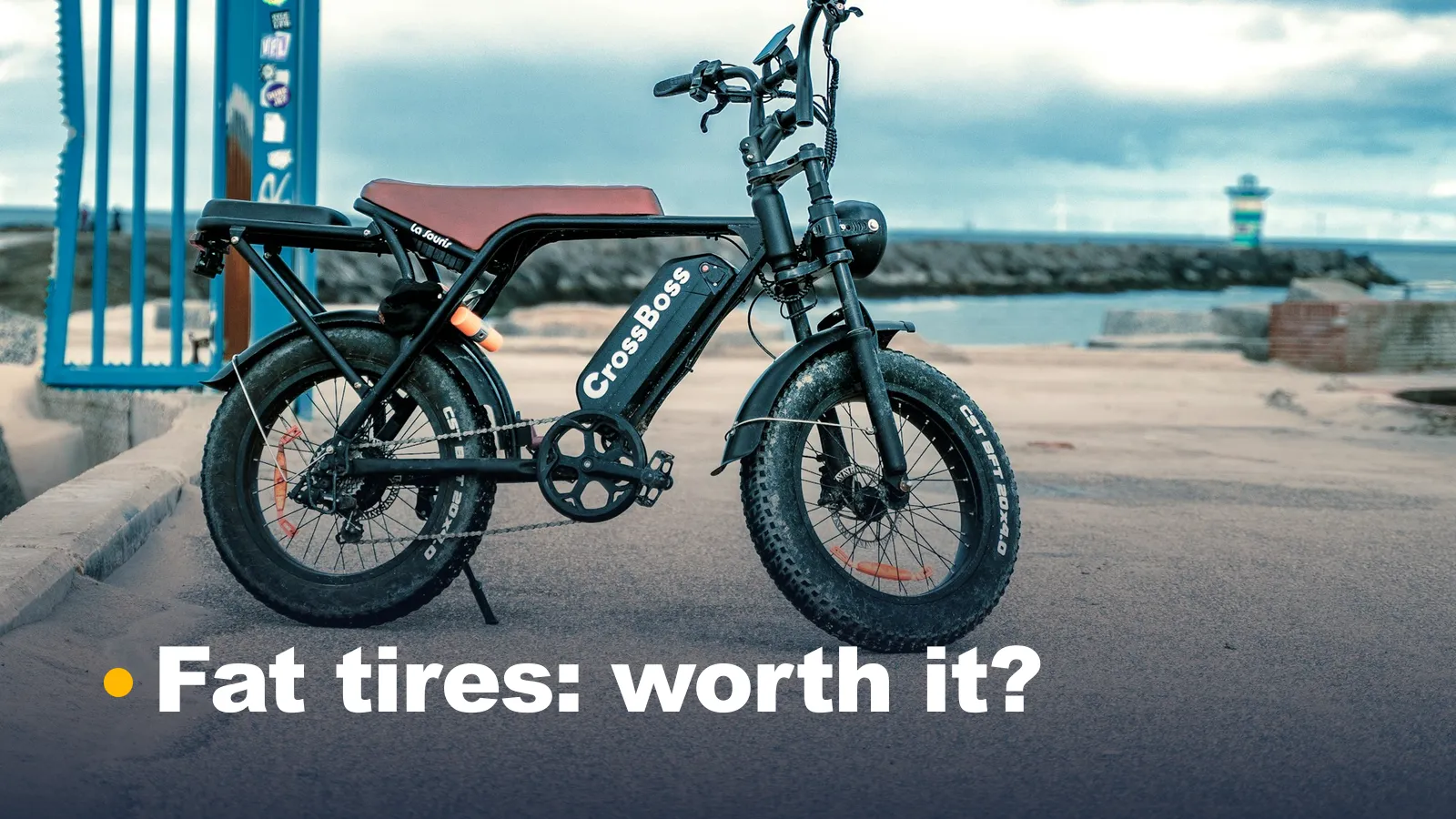
A fat tire e-bike is an electric bike with extra-wide tires, about 3.5 to 4 inches or more, that run at low pressure for grip and comfort on loose or rough ground. This guide explains what counts as a fat tire, how wide tires help, the downsides, where fat tire e-bikes shine, 3 popular examples, and where you can ride them.
What is a fat tire e-bike?
A fat tire e-bike is an e-bike on tires roughly 3.5 inches wide or more. Surly defines fat tires as "roughly 3.5 inches wide and up," while REI puts the starting point at 3.7 inches, so sources draw the line slightly differently.
There are 3 common tire widths:
| Tire type | Width |
|---|---|
| Regular trail tire | About 2.2 to 2.6 inches |
| Plus tire | About 2.8 to 3 inches |
| Fat tire | About 3.5 to 4 inches and up |
Most fat tire e-bikes use 26 x 4 inch tires, while many folding models use 20 x 3 inch tires, which are technically plus width but sold as fat tire bikes.
How do fat tires help?
Fat tires grip and cushion better because they run at low pressure and spread your weight over more ground. Schwalbe's 26 x 4 inch Jumbo Jim tire is rated from 5 to 30 psi, far lower than a road tire.
Schwalbe explains the trade-off: lower pressure gives more comfort and grip, while higher pressure gives less rolling resistance, less wear and fewer punctures. Surly says fat tires were designed for winter and behave "basically like a snowshoe," and they also handle mud, rocks, roots and wet or sandy ground.
What are the downsides of a fat tire e-bike?
The main downsides are weight and efficiency. Aventon says narrower tires are typically lighter and more efficient, and Schwalbe warns that running permanently low pressure leads to faster tire wear.
Fat tire e-bikes are heavy: the 3 below weigh between about 69 and 77 lb with the battery, which makes them harder to lift onto a car rack or carry upstairs. Our guide to how fast an e-bike can go covers what limits speed.
What are fat tire e-bikes good for?
Fat tire e-bikes suit riding where narrow tires struggle. Surly and Aventon name 4 main uses:
- Snow, with studded tires for ice.
- Sand and beaches.
- Rough trails with rocks, roots and mud.
- Potholed or uneven roads, where the wide tires absorb bumps.
They also tend to carry heavy loads: the Aventon Aventure.2 is rated for 400 lb including rider and cargo.
How do popular fat tire e-bikes compare?
The 3 below show the range from full-size off-roaders to a folding model, according to their makers.
| E-bike | Tires | Motor | Battery | Claimed range | Weight |
|---|---|---|---|---|---|
| Aventon Aventure.2 | 26 x 4 in | 750W (1,130W peak) | 720 Wh | Up to 60 miles | 77 lb |
| Rad Power Bikes RadRover 6 Plus | 26 x 4 in | 750W | 672 Wh | 25 to 45 miles | About 73 lb |
| Lectric XP4 (folding) | 20 x 3 in | 500W (1,092W peak) | 500 Wh | Up to 50 miles | 62 lb + 7 lb battery |
Our 5 best electric bikes guide compares 5 e-bikes for different riders.
Where can you ride a fat tire e-bike?
You can ride a fat tire e-bike wherever its class is allowed: tire width doesn't change the class, which depends on the motor, throttle and top assisted speed. Class 1 assists only while pedalling up to 20 mph, Class 2 adds a throttle up to 20 mph, and Class 3 assists pedalling up to 28 mph.
On US federal lands, the Department of the Interior aims to let e-bikes ride where bicycles can, but each agency sets its own policy, so check with the agency that manages the trail. Our guide to e-bike classes explains each class and where it can ride.
Common questions
Are fat tire e-bikes good for commuting?
They can be, especially on rough or potholed roads where the wide tires add comfort. Aventon says narrower tires are lighter and more efficient, so a regular e-bike suits smooth, long commutes better.
What tire pressure should a fat tire e-bike use?
There's no single answer. Schwalbe says the right pressure depends mainly on rider and luggage weight; check the range printed on your tire's sidewall, such as 5 to 30 psi on the Jumbo Jim 26 x 4.
Can you ride a fat tire e-bike in snow?
Yes. Surly says fat tires were designed for winter riding and behave like a snowshoe, and it recommends studded tires for ice.
Are fat tire e-bikes heavier?
Usually. The Aventon Aventure.2 weighs 77 lb with its battery, the RadRover 6 Plus about 73 lb, and the folding Lectric XP4 62 lb plus a 7 lb battery.
Writes guides and reviews for ProductHunter.