Key takeaways
- An e-bike conversion kit adds a motor, battery and controls to a regular bike, turning it into an electric bike.
- There are 4 main types: front hub, rear hub, mid-drive and friction drive; hub kits are easiest to fit, mid-drives handle hills and balance best.
- Check fit first: front hubs need a 100 mm dropout, rear hubs usually 135 mm, and mid-drives like the Bafang BBS02 fit 68 to 73 mm bottom brackets.
- To stay a legal e-bike in the US, the motor must be under 750 watts and stop assisting at 20 or 28 mph, depending on the class.
An e-bike conversion kit is a set of parts, usually a motor, battery, controller and sensor, that turns a regular bicycle into an electric bike. This guide compares the 4 kit types, explains the compatibility checks to make before buying, covers batteries and the legal limits, outlines installation, and weighs a kit against buying a new e-bike.
What types of e-bike conversion kits are there?
There are 4 main types, named by where the motor goes: front hub, rear hub, mid-drive and friction drive, according to Cyclingnews.
| Kit type | Where the motor goes | Pros | Cons |
|---|---|---|---|
| Front hub | Front wheel | Reasonably easy to install | Can affect steering; wheel can slip in the wet |
| Rear hub | Rear wheel | Quick to fit | Can break spokes on weaker wheels |
| Mid-drive | At the pedals (bottom bracket) | Low, central weight; efficient on hills | Harder to fit; more drivetrain wear |
| Friction drive | Presses on the rear tire | Clips to the seatpost | Tire noise and wear; can slip in the wet |
Road.cc adds that hub motors don't wear the rest of your drivetrain, while mid-drives keep their efficiency on steep hills.
How do you check if a kit fits your bike?
Check 4 things before buying, because kits won't fit every bike:
- Dropout spacing, the gap the wheel axle slots into. Sheldon Brown lists 100 mm at the front, and 130 mm (road) or 135 mm (mountain and disc road) at the rear.
- Axle type. Swytch says its motor wheel can't fit bikes with thru-axles, the thick bolt-through axles on many newer bikes.
- Brake type. Match the kit wheel to your brakes, disc or rim.
- Bottom bracket, the frame tube the pedal axle runs through, for mid-drives. The Bafang BBS02 fits 68 to 73 mm bottom brackets.
Cyclingnews warns that a regular bike frame may not be designed for a motor's forces. For a front hub, Make magazine calls a torque arm, a bracket that stops the axle twisting in the fork, essential on weaker aluminum forks.
What battery do you need for a conversion kit?
Most kits include a battery or name a compatible one; mount it where your frame has strong attachment points. A downtube battery needs a sturdy pair of bottle cage bolts and more space than a bottle, and a rack battery needs rack mounts.
Choose a battery certified for safety. UL 2849 covers an e-bike's whole electrical system and UL 2271 covers light electric vehicle batteries. The CPSC says to use only the charger provided or recommended by the maker, never charge while asleep or away, and never use a battery modified by unqualified people.
Is a converted e-bike legal?
Yes, if it stays within e-bike limits. Under the PeopleForBikes model law, adopted by at least 36 states, an electric bicycle has working pedals and a motor under 750 watts, and its class sets its top assisted speed:
| Class | How the motor helps | Stops assisting at |
|---|---|---|
| Class 1 | Only while pedalling | 20 mph |
| Class 2 | Throttle, no pedalling needed | 20 mph |
| Class 3 | Only while pedalling | 28 mph |
The model law also requires the motor to cut out when you stop pedalling or brake. Our guide to e-bike classes explains each class in detail.
How do you install an e-bike conversion kit?
Installation depends on the kit type: front-wheel kits are the simplest, and mid-drives take the most work. Swytch says its front-wheel kit fits in 3 steps and 25 to 45 minutes:
- Swap in the motor wheel, moving your tire across.
- Attach the pedal sensor.
- Mount the battery pack on the frame or handlebar.
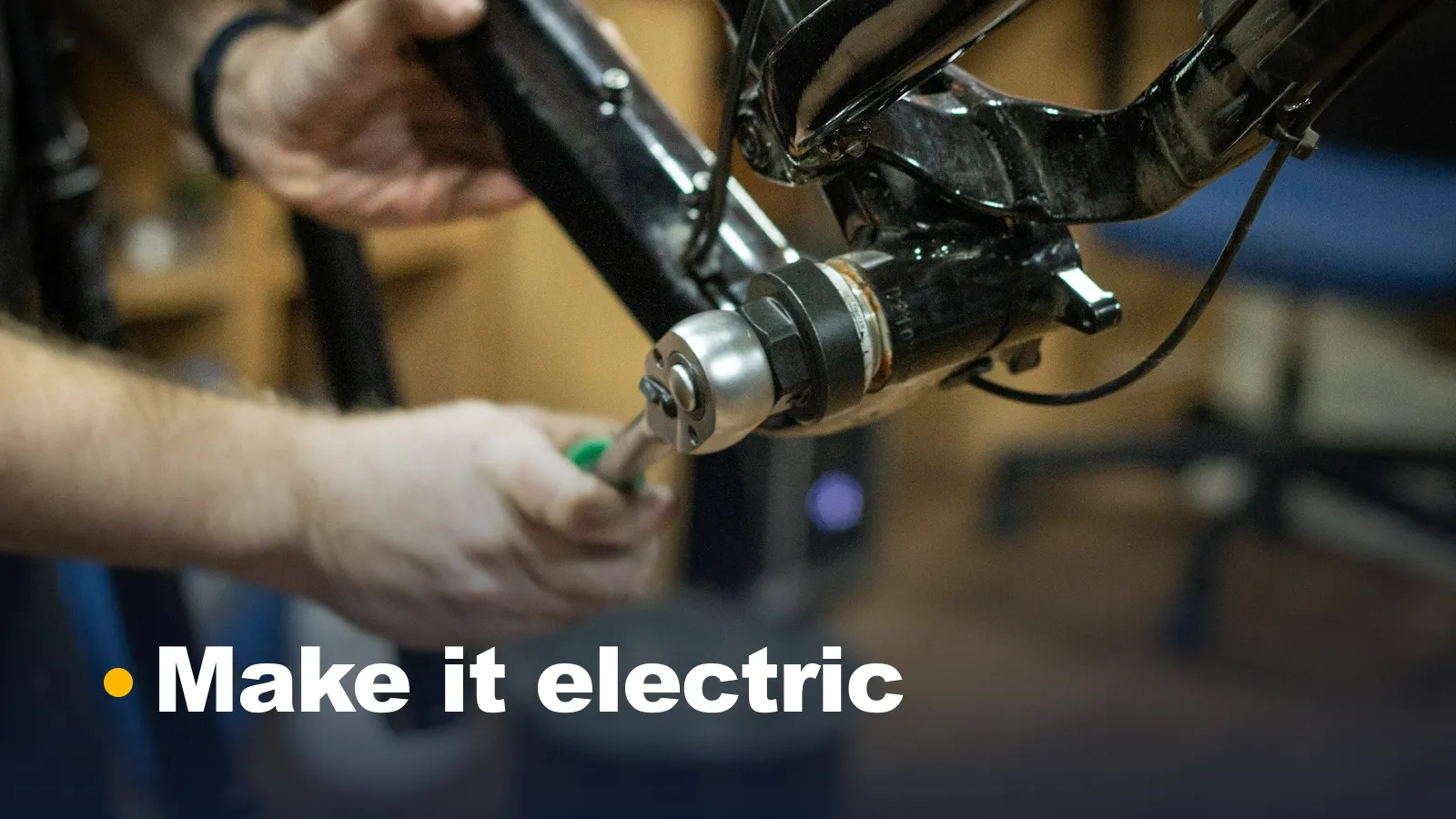
A mid-drive like the Bafang takes about 3 hours: you remove the cranks with a crank puller, remove the bottom bracket, then fit the motor. You'll need a bike stand, Allen keys, a crank puller and a bottom bracket tool, or you can ask a bike shop to fit it.
Should you convert a bike or buy an e-bike?
Convert if you already own a suitable bike and want to keep it; buy a new e-bike if you want everything designed to work together. Cyclingnews says a new e-bike is likely to be better integrated and often has stronger brakes.
A conversion can void your bike's original warranty, and it costs less only if you don't need to buy a bike as well. Our 5 best electric bikes guide compares ready-made e-bikes, and our guide to commuting by e-bike covers running costs.
Common questions
Can any bike be converted to electric?
Not every bike. Kits need the right dropout width, axle type, brake type and bottom bracket, and Swytch says its wheel can't fit bikes with thru-axles. Cyclingnews also warns some frames aren't designed for a motor's forces.
Is a conversion kit cheaper than a new e-bike?
It can be, if you already own a suitable bike, according to Cyclingnews. A new e-bike is designed from the ground up to run electric and often has stronger brakes, and converting can void your bike's warranty.
How long does it take to fit an e-bike conversion kit?
It depends on the type. Swytch says its front-wheel kit takes 25 to 45 minutes, while one guide puts a Bafang mid-drive install at about 3 hours.
Do I need a torque arm for a hub motor?
For a front hub motor, yes in most cases. Make magazine calls a torque arm essential on weaker aluminum forks and recommends one even on steel forks.
Writes guides and reviews for ProductHunter.