Key takeaways
- Makers measure battery life in charge cycles, not years: Specialized warranties its Turbo batteries to keep 75% of their capacity for 2 years or 300 cycles.
- On one charge, Bosch says an e-bike can cover 15 to 140 miles depending on assist level, terrain, rider weight, wind and temperature.
- Shallow cycles last longer: Battery University's figures show about 300 cycles at 100% depth of discharge and about 1,000 at 40%.
- Store the battery at 30 to 60% charge between 32°F and 68°F, and unplug the charger once it's full, says Bosch.
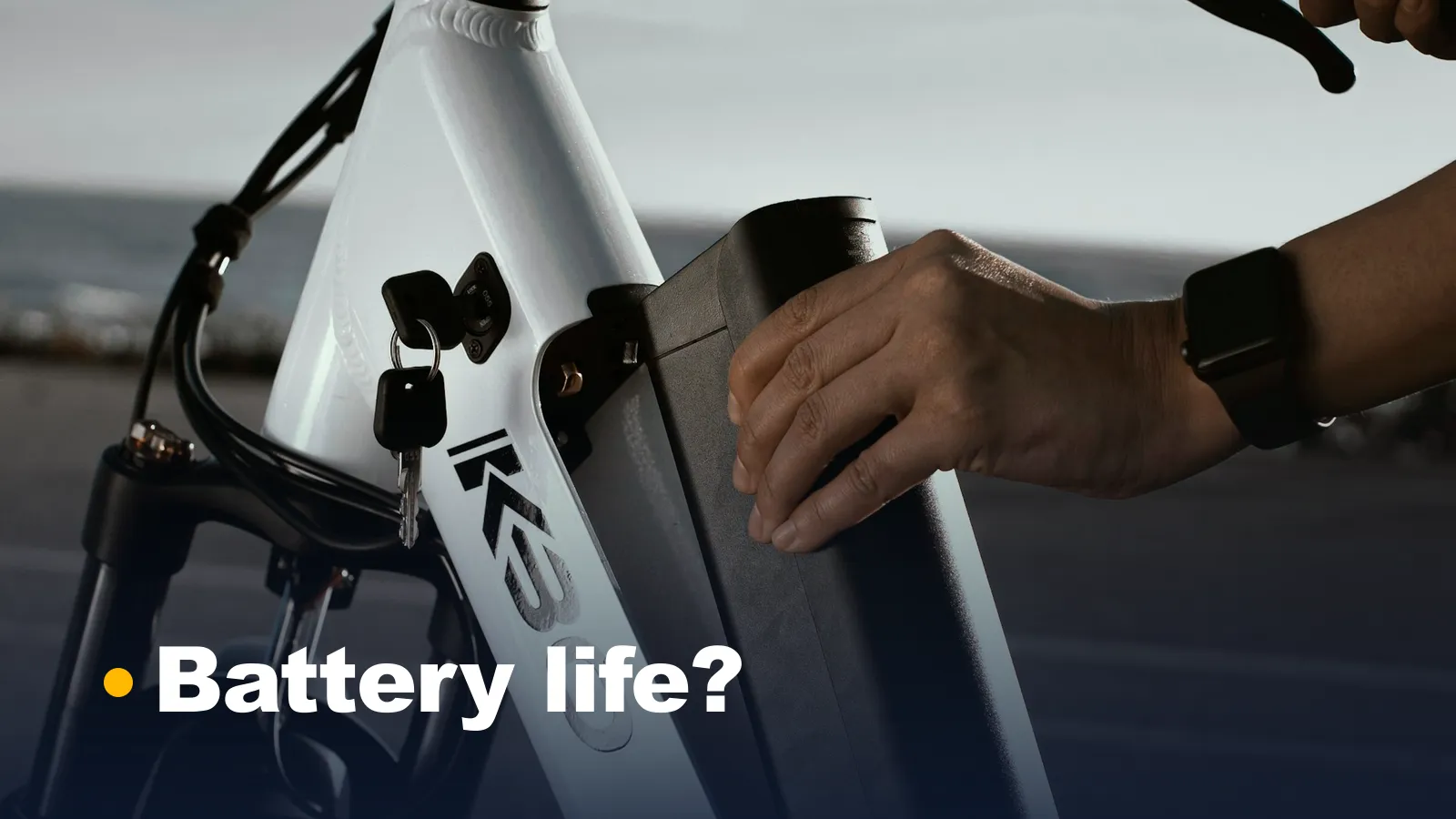
An e-bike battery is a rechargeable lithium-ion pack that powers the motor, and its life is measured in charge cycles rather than years. This guide explains how long a battery lasts, what a charge cycle is, how far an e-bike goes on one charge, 6 habits that slow wear, and when to replace it.
How long does an e-bike battery last?
An e-bike battery lasts several hundred full charge cycles before it holds noticeably less energy, but no maker promises a set number of years. Bosch says "an exact service life cannot be predicted", because heavy use, heat and extreme charge levels all speed up wear.
Warranties show what makers expect. Specialized says its Turbo batteries keep at least 75% of their capacity for 2 years or 300 charge cycles, whichever comes first. A battery doesn't stop at that point: it simply holds less, so your range shrinks.
What is a charge cycle?
A charge cycle is one full 0 to 100% charge, added up across partial charges. Trek's example: charging 20% a day from Monday to Friday adds up to one cycle. Specialized counts the same way, so putting 250 Wh into a 500 Wh battery is half a cycle.
How deeply you drain the battery matters. Battery University, a lithium-ion research site, counts cycle life as the cycles until a battery holds 70% of its original capacity. Its figures for NMC (nickel manganese cobalt) cells, the lithium-ion type most e-bikes use, show 6 depths:
| Battery used per cycle | Cycles until 70% capacity |
|---|---|
| 100% | About 300 |
| 80% | About 400 |
| 60% | About 600 |
| 40% | About 1,000 |
| 20% | About 2,000 |
| 10% | About 6,000 |
How far can an e-bike go on one charge?
Bosch says an e-bike can go 15 to 140 miles (24 to 230 km) on one charge, depending on how and where you ride. Bosch lists these 7 range factors: assist level, hills, rider and cargo weight, surface, wind, tire pressure, and frequent stops and starts. Pedaling at 60 to 80 rpm also helps the motor work efficiently.
Battery size sets the starting point, measured in watt-hours (Wh), a unit of stored energy. These are 3 makers' claims:
| E-bike | Battery | Claimed range |
|---|---|---|
| Specialized Turbo Vado 4.0 | 710 Wh | Up to 90 miles in Eco |
| Rad RadWagon | 720 Wh | 20 to 60 miles |
| Rad RadRunner Max | 672 Wh | 19 to 61+ miles |
Cold weather cuts range because the battery's internal resistance rises, Bosch says. Our guide to what affects the cost of an e-bike explains how battery size changes the price.
How do you make an e-bike battery last longer?
Keep it cool, avoid sitting at full or empty, and use the right charger. Follow these 6 habits:
- Store it part-charged. Bosch says 30 to 60%, and Trek says 40 to 60% if you won't ride for over 30 days.
- Store it cool and dry. Bosch says 32°F to 68°F (0°C to 20°C) in a dry place.
- Charge at room temperature. Bosch allows 32°F to 104°F (0°C to 40°C). Bring a cold battery indoors and let it warm up first.
- Unplug when it's full. Bosch and Rad both say to disconnect the charger after charging.
- Charge to 100% only when you need it. Bosch says to fully charge only if it's really necessary, and Rad says not to run it completely flat.
- Use the maker's charger. Bosch says to use only chargers made for its batteries.
Heat and a full charge together wear a battery fastest. Battery University's figures for capacity left after a year of storage:
| Storage temperature | Stored at 40% | Stored at 100% |
|---|---|---|
| 32°F (0°C) | 98% | 94% |
| 77°F (25°C) | 96% | 80% |
| 104°F (40°C) | 85% | 65% |
Does pedaling charge an e-bike battery?
Usually not: pedaling drives the wheels, and the battery only charges from the wall. The exception is regenerative braking, a feature on some hub-motor e-bikes that turns braking or coasting into a little electricity.
Rad's direct-drive hub motors offer it, while its geared-hub models don't. Aventon's Level 4 REC and Pace 5 REC also have it. The gain is small: Electrek's testing found about 4 to 5% more range on average and about 8% at most on hilly routes.
When should you replace an e-bike battery?
Replace it when it no longer holds enough charge for your rides, or straight away if it's damaged. Bosch dealers can measure a battery's remaining capacity with Bosch's CapacityTester.
Stop using a battery that overheats, leaks, smells, or changes shape or colour, says the New York City Fire Department (FDNY). It also warns never to use aftermarket or generic batteries or chargers. Look for UL 2849 certification on the e-bike, a safety standard covering its whole electrical system including the battery.
Never put an old battery in the trash. Call2Recycle runs a US e-bike battery recycling program with drop-off at participating bike shops. Our guide to riding an e-bike in the rain covers keeping the battery dry, and our 5 best electric bikes list compares battery sizes.
Common questions
Should I leave my e-bike battery plugged in all the time?
No. Bosch says to disconnect the battery and charger once charging finishes, and Rad says leaving them connected reduces range. The New York City Fire Department also warns never to leave a battery charging overnight.
Does pedaling an e-bike charge the battery?
Usually not. Pedaling turns the wheels, not the battery. A few hub-motor e-bikes, such as Rad's direct-drive models and Aventon's Level 4 REC, have regenerative braking that puts some energy back while braking or coasting.
Is it worth replacing an e-bike battery?
Often, yes, if the rest of the bike is in good shape. Use the maker's own battery, since the FDNY warns never to use aftermarket batteries or chargers, and recycle the old one at a Call2Recycle drop-off.
Do e-bike batteries have a memory effect?
No. Bosch says lithium-ion batteries have no memory effect, so you can top up at any charge level without harming them.
Writes guides and reviews for ProductHunter.