Key takeaways
- Active noise cancellation (ANC) uses microphones to read outside sound and play an opposite signal that cancels it when the 2 sound waves meet.
- ANC works best on steady, low-pitched sounds such as an air conditioner or traffic hum, and is most effective below 1 kHz.
- Passive isolation from ear cushions or ear tips blocks higher-pitched sounds, so the best results come from combining both.
- ANC works without music, and it can help protect your hearing by letting you listen at a lower volume.
Noise cancelling is a headphone technology that reduces the outside sound you hear, either by blocking it physically or by cancelling it with an opposite sound wave. This guide explains how active noise cancellation works, the 3 types of ANC microphones, how passive isolation helps, transparency modes, what ANC can't block, and how it affects your hearing.
How does active noise cancellation work?
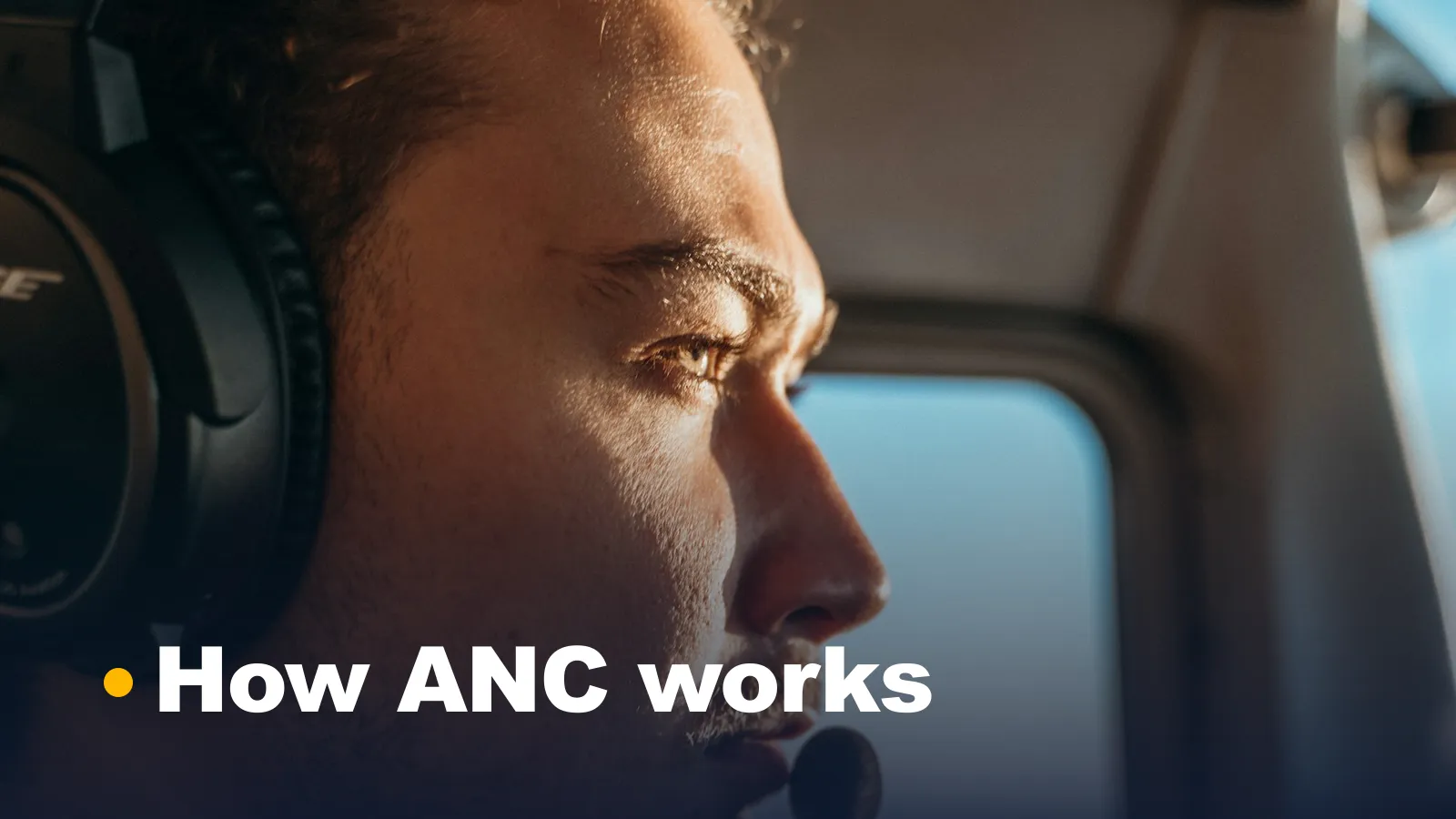
Active noise cancellation (ANC) works by playing an opposite sound wave: microphones read the noise around you, and the headphones emit an opposite signal that cancels the noise when the 2 sound waves meet inside your ear canal, according to Bose.
The process takes 3 steps:
- Listen. Outward-facing microphones pick up the sound around you.
- Invert. The headphones create an opposite signal for that sound.
- Cancel. The 2 waves meet in your ear and cancel each other, so less noise reaches you.
Apple says AirPods also use an inward-facing microphone that listens inside your ear for any noise left over, and cancels that too.
What are feedforward, feedback and hybrid ANC?
These are the 3 ways headphones place their noise-cancelling microphones. Feedforward uses a microphone outside the ear cup, feedback uses one inside, and hybrid uses both.
| Type | Microphone position | What it hears |
|---|---|---|
| Feedforward (FF) | Outside the ear cup | Noise around you before it reaches your ear |
| Feedback (FB) | Inside, between the speaker and your eardrum | Noise that gets through to your ear |
| Hybrid | Both | Both, for cancelling across a broader range |
Sony says using feedforward and feedback microphones together cancels noise across a broad frequency range.
What can noise cancelling block, and what can't it?
ANC blocks steady, low-frequency sounds best, such as the hum of an air conditioner, an engine or passing traffic. It is less effective on sudden, sharp sounds like a dog barking or a car horn, and on mid- and high-pitched sounds, according to Bose.
A study from the National Research Council of Canada found active noise reduction is most effective below 1 kHz (1,000 hertz, a measure of pitch). In a 2023 test published in The Hearing Review, AirPods Pro 2 with ANC reduced noise by an average of 27 dB across frequencies, and by about 35 dB at 250 Hz.
What is passive noise isolation?
Passive noise isolation is the sound blocked physically by ear cushions or ear tips that cover or fill your ears. It works well on high-pitched sounds, which is where ANC is weakest.
The same Hearing Review test found the ear-tip seal alone reduced sounds above 3,000 Hz by about 30 dB. Bose says over-ear foam cushions create a tight seal for extra isolation, and Apple says AirPods need a complete seal to protect your hearing fully. The best noise reduction comes from combining both.
What are transparency and adaptive modes?
Transparency mode lets outside sound in so you can hear what's around you, and adaptive mode adjusts the noise cancelling automatically based on your surroundings, according to Apple.
Bose calls its version Aware Mode and Sony calls it Ambient Sound mode. Apple suggests adaptive mode when sound levels change, such as in city traffic.
Is noise cancelling bad for your ears?
No. The World Health Organization (WHO) recommends noise-cancelling, well-fitted headphones so you don't turn the volume up in noisy places. The Hearing Review study concluded ANC can help reduce the risk of noise-induced hearing loss.
The risk to hearing comes from volume and time, not from ANC. WHO sets these weekly safe listening limits:
| Sound level | Safe listening time per week |
|---|---|
| 80 dB | 40 hours |
| 85 dB | 12 hours 30 minutes |
| 90 dB | 4 hours |
| 100 dB | 20 minutes |
WHO advises keeping the volume below 60% of maximum, and Cleveland Clinic says noise cancelling is best used in a safe setting, because you can miss traffic. Our guide to sleeping with noise-cancelling headphones covers using them at night, and our Neurable MW75 review tests a pair of ANC headphones.
Common questions
Do you have to listen to music with noise-cancelling headphones?
No. Bose says noise-cancelling headphones still block outside noise with no music playing, though ANC uses some battery even when nothing is playing.
Is 100% noise cancellation possible?
No. ANC is most effective below 1 kHz and less effective on sudden or higher-pitched sounds. In one test, AirPods Pro 2 with ANC reduced noise by an average of 27 dB, not to silence.
Do noise-cancelling headphones block out voices?
Only partly. Bose says ANC reduces mid- and high-frequency sounds less well than low ones, and speech sits in that higher range, so you'll usually still hear people talking nearby.
Why do noise-cancelling headphones feel like pressure in my ears?
Bose says your brain can read the missing low-frequency sound as a pressure difference. A SoundStage engineer who measured it found no actual pressure change.
Writes guides and reviews for ProductHunter.