Key takeaways
- Heart rate variability (HRV) is the slight change in the amount of time between your heartbeats, measured in milliseconds.
- A high HRV usually means your body adapts well to change; a low HRV can be a sign of current or future health problems.
- Cleveland Clinic lists 4 things that lower HRV: poor or short sleep, a higher BMI, stress, anxiety or depression, and aging.
- HRV varies widely between people and falls with age, so compare your numbers only with your own baseline.
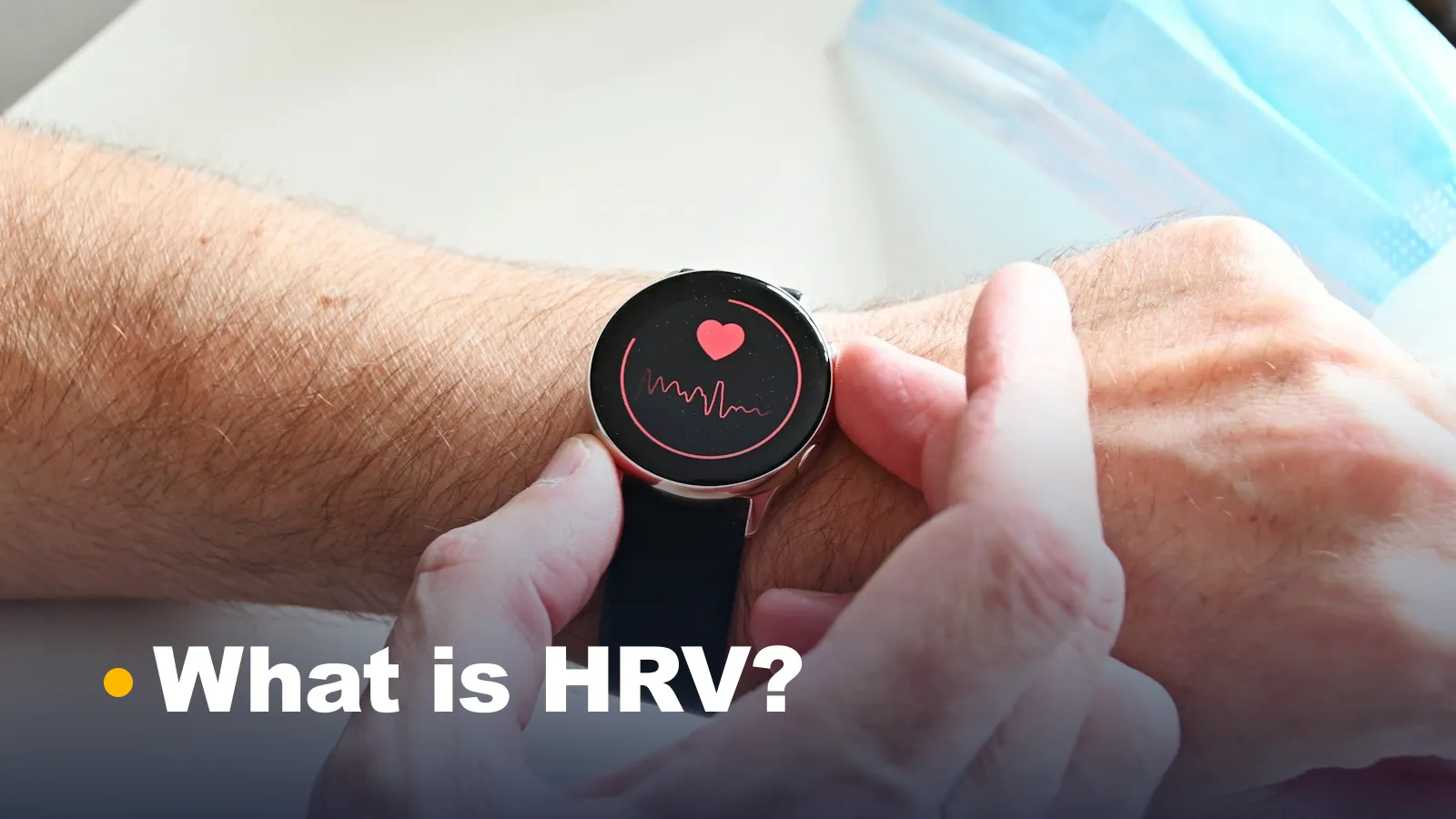
Heart rate variability (HRV) is the slight change in the amount of time between your heartbeats, a difference of a fraction of a second that shows how well your heart adapts to the world around you. This guide covers what HRV tells you, how it works, how it is measured, what a good number is, what lowers it and how to raise it.
What does HRV tell you?
HRV tells you how well your body adapts to change. Cleveland Clinic says a high HRV usually means your body copes with many kinds of change, while a low HRV can be a sign of current or future health problems.
A low HRV is more common in people with higher resting heart rates, because a faster heartbeat leaves less time between beats. Cleveland Clinic links low HRV with 6 conditions: diabetes, high blood pressure, abnormal heart rhythms, asthma, anxiety and depression.
How does heart rate variability work?
HRV works through your autonomic nervous system, the part of your nervous system that runs without you thinking about it. It has 2 branches that pull your heart rate in opposite directions.
- Sympathetic nervous system. It raises heart rate and blood pressure in emergencies, the "fight-or-flight" response.
- Parasympathetic nervous system. It slows your heart rate and blood pressure to relax you, especially after fight-or-flight.
The constant push and pull between the 2 makes the gap between beats change slightly from beat to beat.
How is HRV measured?
HRV is measured with an electrocardiogram (EKG) in a medical setting, or with a heart rate monitor worn for minutes up to 24 hours. Cleveland Clinic says longer monitoring gives the best data.
| Method | Where | Accuracy |
|---|---|---|
| EKG | Doctor's office or hospital | Measures HRV correctly |
| Chest strap monitor | Athletes, at home | More sensitive than a pulse oximeter |
| Wrist tracker or ring | Everyday wear | Cleveland Clinic says wrist trackers usually aren't sensitive enough |
Smart rings such as Oura use HRV in their daily scores. Our guide to what the Oura Ring tracks explains how it turns HRV into a Readiness score.
What is a good HRV number?
A good HRV number is one that is normal for you. On Cleveland Clinic's clinical scale, the standard deviation of time between heartbeats over 24 hours (SDNN) is unhealthy below 50 ms, compromised from 50 to 100 ms, and healthy above 100 ms.
HRV gets lower with age, and Cleveland Clinic says HRV that is normal for one person may not be normal for someone else. Wearables usually report a shorter overnight measurement, so judge a ring or watch reading against your own baseline on the same device.
What lowers your HRV?
Cleveland Clinic lists 4 things that lower HRV: poor or short sleep, a higher body mass index (BMI), stress, anxiety or depression, and aging.
Only aging is outside your control. Our guide comparing Oura and WHOOP shows how 2 popular trackers use HRV to judge recovery.
How can you improve your HRV?
You can improve your HRV in 3 ways, according to Cleveland Clinic: look after your body with regular activity and healthy food, manage stress, anxiety or depression, and try biofeedback training.
Biofeedback training teaches you to control your breathing, which can raise HRV and lower stress. Our best smart rings guide compares 5 rings that track HRV overnight, and our WHOOP 4.0 review covers a strap built around recovery.
Common questions
Is an HRV of 45 ms normal?
It can be. HRV varies widely between people and falls with age, and wearables and clinical tests measure it differently. Cleveland Clinic says HRV that is normal for one person may not be normal for someone else, so compare 45 ms with your own usual number.
Is 170 a good HRV?
On Cleveland Clinic's clinical scale, a 24-hour SDNN above 100 ms counts as healthy. A wearable's overnight HRV is a different measurement, so a reading of 170 is best judged against your own baseline on the same device.
Why don't doctors look at HRV more often?
Accurate HRV needs an EKG or a dedicated monitor, ideally over 24 hours, and the number is personal, varying with age. Cleveland Clinic says most wrist trackers usually aren't sensitive enough to measure HRV accurately.
How do you increase heart rate variability?
Cleveland Clinic suggests 3 ways: regular physical activity and healthy food, reducing and managing stress, and biofeedback training that uses controlled breathing.
Writes guides and reviews for ProductHunter.